Guatemala
| Guatemala | |
|---|---|
.svg) | |
| Guatemala is within: | |
| Region: | Americas |
| Subregion: | Latin America and the Caribbean |
| Intermediate region: | Central America |
Guatemala is the northernmost country in Central America, bordered by Mexico to the north and west, Belize, the Caribbean Sea, Honduras, and El Salvador to the east, and the Pacific Ocean to the south. In 2021, the total rural population in Guatemala was 8,712,360 and the total crop cultivated area was 2,737,000 ha.[1] The agricultural sector plays a vital role in Guatemala's economy, contributing approximately 25% to the GDP and employing 50% of the workforce.[2]
Despite having the largest economy in Central America and strong economic growth, poverty reduction has been limited, leaving Guatemala with some of the highest poverty and inequality rates in Latin America and the Caribbean. A significant portion of the population, particularly in rural and indigenous areas, remains underserved, with poverty estimated at 55.1 percent in 2023. [3]
The increasing population has a strong need for staple foods like maize, wheat, potatoes, and beans. Yet, national food production falls short of satisfying the minimum requirements, leading to chronic malnutrition in 50 percent of children under five, with a significant impact on the indigenous population, which makes up half of the country’s residents.[4]
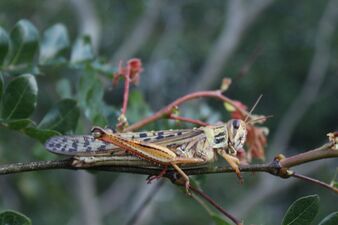
Recently, there has been more CAL activity in Guatemala after many years without reports.[5] In 2021, Guatemala declared a state of emergency due to CAL swarms that likely came from Mexico.[6]
Species gallery
- Highlighted species for Guatemala
-

-

-

-

-

-

-

-

-

-
-

-

-
-

-

-

Organizations
Locusts and grasshoppers are typically managed through a national plant protection system led by a country’s plant protection organization, ministry of agriculture, or equivalent biosecurity authority. They are often supported by specialized pest control branches, natural resource agencies, and regional bodies when outbreaks cross borders. These agencies are usually the first point of contact for surveillance, reporting, permits, quarantine decisions, and control operations. If the country belongs to one of the FAO locust commissions, those bodies provide a regional framework for early warning, field surveillance, information sharing, and coordinated response, helping countries align monitoring, contingency planning, and control actions across borders.
| Organization name | Acronym | Website | Type | Focus | Geographic purview |
|---|---|---|---|---|---|
| Inter-American Institute for Cooperation on Agriculture | IICA | View | Non-governmental Organization | Development | Antigua and Barbuda, Argentina, Bahamas, Barbados, Belize, Bolivia, Brazil, Canada, Chile, Costa Rica, Colombia, Dominica, Dominican Republic, Ecuador, El Salvador, Guatemala, Grenada, Guyana, Haiti, Honduras, Jamaica, Mexico, Nicaragua, Panama, Paraguay, Peru, Saint Kitts and Nevis, Saint Lucia, Saint Vincent and the Grenadines, Suriname, Trinidad and Tobago, United States, Uruguay, Venezuela |
| International Regional Organization of Plant and Animal Health | OIRSA | View | Intergovernmental Organization | Management, Governance, Education | Mexico, Guatemala, El Salvador, Honduras, Nicaragua, Costa Rica, Panama, Dominican Republic |
Resources
| Name | Species purview | Year published | Resource link | Descriptive keyword | Language | Geographic purview | Author |
|---|---|---|---|---|---|---|---|
| Action plan for managing the Central American locust | 2019 | View | Management, Biology, Species identification, Biopesticide, Robotics, Drones, Technology, Pesticide management, Survey | Spanish | Mexico, Guatemala, El Salvador, Honduras, Nicaragua, Costa Rica, Panama, Dominican Republic | International Regional Organization of Plant and Animal Health | |
| Situation and recommendations for controlling the Central American locust in the countries of the OIRSA region | 2020 | View | Management, Geographical differences, Situation bulletin | Spanish | Mexico, Belize, Guatemala, El Salvador | International Regional Organization of Plant and Animal Health |
Highlighted media coverage
| Name | Author | Language | Species purview | Substance | Resource link | Year published |
|---|---|---|---|---|---|---|
| Guatemala se declara en emergencia sanitaria por plaga de langosta | Spanish | News article | 2021 |
Projects
No results found in the database at this time—please reach out if you have any to share!
References
- ↑ Food and Agriculture Organization of the United Nations (FAO) (2021) AQUASTAT database. Retrieved September 9, 2024, from https://data.apps.fao.org/aquastat/?lang=en
- ↑ Food and Agriculture Organization of the United Nations (FAO) (n.d.) Guatemala: Plant breeding partners. FAO. Retrieved September 9, 2024, from https://www.fao.org/in-action/plant-breeding/our-partners/americas/guatemala/en/#:~:text=In%20fact%2C%20there%20are%20areas,related%20biotechnology%20capacity%20in%20Guatemala
- ↑ World Bank (2023) Guatemala overview. Retrieved from https://www.worldbank.org/en/country/guatemala/overview#:~:text=Guatemala%20is%20the%20largest%20economy
- ↑ Food and Agriculture Organization of the United Nations (2015) Perfil de País – Guatemala. https://openknowledge.fao.org/server/api/core/bitstreams/c95f3dcf-fef0-48a7-bd83-b8725e2fc26b/content
- ↑ SENASICA-DGSV (2016) Langosta Centroamericana [Schistocerca piceifrons piceifrons (Walker, 1870)] (Orthoptera: Acrididae). Servicio Nacional de Sanidad, Inocuidad y Calidad Agroalimentaria-Dirección General de Sanidad Vegetal-Centro Nacional de Referencia Fitosanitaria-Grupo Especialista Fitosanitario. Ficha Técnica. Tecámac, México 18 p. https://hopperwiki.org/images/c/cc/Technical_paper_on_the_Central_American_locust.pdf
- ↑ Milenio (2024) Guatemala declara emergencia sanitaria por plaga de langosta. Milenio. https://www.milenio.com/internacional/guatemala-declara-emergencia-sanitaria-plaga-langosta#google_vignette