High Plains grasshopper (Dissosteira longipennis)
| Dissosteira longipennis | |
|---|---|
 | |
| Other common names | |
| High Plains locust | |
| Taxonomic classification | |
| Suborder: | Caelifera |
| Family: | Acrididae |
| Subfamily: | Oedipodinae |
| Tribe: | Trimerotropini |
| Genus: | Dissosteira |
| Scientific name | |
| Dissosteira longipennis (Thomas, 1872) | |
| Geography | |
| Native countries: | |
| Pest status | |
| Known pest | |
Dissosteira longipennis is exclusively found in the High Plains of the United States. It is best known for its 1934-1940 catastrophic outbreak where almost 24 million acres across five states were affected. There has not been an outbreak of this species since. Today, the High Plains grasshopper is only occasionally recorded among rangeland grasshopper communities. There is limited research available on this species and the majority of the information here comes from a report published by the USDA in 1958 and observations in 1997 by the USDA.
Taxonomy
For full nomenclature and taxonomic details of this taxon, see Orthoptera Species File
Identification
Dissosteira longipennis is a species of band-winged grasshoppers (subfamily Oedipodinae, family Acrididae), which are a distinctive and diverse feature of the semi-arid grasslands of North America. While most species are harmless and not targets of control, the group also includes some of the most destructive pest species. It ranges from delicate, inconspicuous grasshoppers to the largest and most visually striking ones in North America. Anatomically, they are easily recognized by their large, lobed hindwings, often marked with spots or bands, features that set them apart from other grasshopper subfamilies. These hindwings also play a role in their behavior; many species produce a loud snapping crepitation during flight, which can be heard from across a pasture or field, making them identifiable even to those unfamiliar with insect taxonomy.[1] Although, when flushed, D. longipennis flights are generally silent and lack crepitation, although a faint rustling of the wings can be heard.[2]
Identification details

Dissosteira longipennis is is notable for its large size, striking black hindwings, and fast, elusive flight. The hindwings feature a transparent outer margin surrounding a broad black area that widens at the apex and bears several large dark spots. The forewings are pale tan with numerous large brown spots. The median pronotal crest is tall and sharply incised once. The inner surface of the hind femur is yellow with two large dark marks near the middle, and the hind tibia is a distinctive golden color. Wingspans range from 2.5 to 3.375 inches in males and 3.25 to 4 inches in females. Flight distances vary from about 1 foot in the early morning to over 90 feet around midday, at heights ranging from 4 inches to 3 feet. Short flights are typically straight, while longer flights may follow straight, zig-zag, or winding paths. Near the end of a long flight, the grasshoppers sometimes make a right-angle turn before landing.[2]
D. longipennis nymphs have a nearly vertical head with filiform antennae, mostly pale tan with dark tips, small triangular lateral foveolae, and tan or brown compound eyes often with light spots and a narrow pale band behind the eyes. The pronotum has a strongly raised median carina incised once. The hind femur is tan with diagonal dark bars, and the inner medial area bears two or three black bars. The hind tibia changes with development: black with a pale yellow ring in early instars, black and tan or entirely golden in mid-instars, and fully golden in the oldest nymphs. The body is generally tan with brown spots and a pale unmarked venter. Younger nymphs are distinguished by the high pronotal crest and spotted body, while older nymphs are recognized by the golden hind tibia and elevated pronotal crest.[2]
Resembles Dissosteira carolina, but distinguished by wings with a transparent bluish base and a clear to whitish outer margin rather than yellowish. It also closely resembles D. spurcata, though that slightly smaller species has pale whitish to yellowish wings with a narrow, sometimes faint, dark border and is found west of the Rocky Mountains.[3]
Identification resources
| Title | Author(s) | Year | Geographic purview | URL |
|---|---|---|---|---|
| Common Grasshoppers of Montana Cropland and Rangeland | Montana State University | View URL | ||
| Grasshoppers (Acrididae) of Colorado | Colorado State University,John Capinera,TS Sechrist | 1982 | ||
| A Manual of the Grasshoppers of New Mexico | New Mexico Cooperative Extension Service,D.B. Richman, D.C. Lightfoot, C.A. Sutherland and DJ. Ferguson | 1993 | View URL | |
| Orthoptera of Northern Great Plains | North Dakota State University | 2007 | ||
| The grasshoppers of Nebraska | Animal and Plant Health Inspection Service,Mathew L. Brust, Wyatt Hoback and Robert J. Wright | 2009 | View URL | |
| Field Guide to Common Western Grasshoppers | United States Department of Agriculture,Robert E. Pfadt | 2002 | ||
| Grasshoppers of the Western United States | United States Department of Agriculture | View URL | ||
| ARS grasshopper species fact sheets | Agricultural Research Services and United States Department of Agriculture | 1994 | ||
| The Grasshoppers of the Western U.S. Lucid mobile app | APHIS PPQ Science & Technology Insect Management and Molecular Diagnostics Laboratory (Phoenix Station), United States Department of Agriculture and Center for Plant Health Science and Technology of the USDA | 2016 |
Featured resources
Distribution
The High Plains grasshopper lives on the High Plains, a subregion of the Great Plains of the United States, where it has occasionally built up to outbreak levels in parts of Colorado, Kansas, New Mexico, Oklahoma, and Texas.[4]
Biology
Dissosteira longipennis hatches at an intermediate time, with first instars appearing two to three weeks after those of Aulocara elliotti.[2] D. longipennis has a single generation each year. Eggs deposited in the fall hatch the following spring, after which nymphs feed and develop through late spring and early summer. The timing of egg-laying, hatching, nymphal development, and adult emergence varies among regions and can shift from year to year within the same area due to local influences such as climate, topography, elevation, latitude, slope exposure, and vegetation.[4]
In Colorado, the first hatch in 1939 occurred on May 2, but an unusually warm spring in eastern New Mexico and the Texas Panhandle caused hatching to begin two to three weeks earlier, on April 21. In 1997, hatching in Bent and Otero counties, Colorado, was estimated to start on May 14. The hatching period typically lasts 11 to 18 days but can extend up to 30 days during cold spells. Egg beds with southern exposures hatch earlier and more rapidly than those facing north.[2]
Observations in 1939 showed that most eggs were laid between 9 a.m. and noon, when air temperatures were between 80° and 90° F. Over 90% of egg beds are found in buffalo and grama grass rangelands, with smaller numbers in tallgrass, weedy grassland, small grains, sorghum or corn stubble, and abandoned fields. Egg beds are rarely found outside grassland habitats and occurred mostly on exposed slopes with firm sandy-loam soil. However, some have been found in bottomlands, on hilltops, and even in rocky ground in northeastern New Mexico and southern Colorado. In buffalo–grama rangeland, pods were placed at the bases of grass plants and in nearby bare spots. The long egg masses lay nearly horizontally 1–2 inches below the surface, with eggs arranged in vertical rows. A 1939 survey of 187 pods found 32–84 eggs per pod, averaging 65.[4]

Nymphs develop in late spring when temperatures are warm and grasses are fresh and green. In 1939, observations of first nymphs and adults indicated that development took 44 to 45 days in Colorado, New Mexico, and the Texas Panhandle. Most nymphs in New Mexico and Texas went through five instars, whereas Colorado had six.[4][2]
During outbreak years, enormous numbers of hatching nymphs, up to 2,000 per square yard, quickly disperse from egg beds (which range from 0.5 to 200 acres in size and average around 15 acres) and move in bands in search of food. Dispersal typically begins near the end of the first week after emergence and accelerates as the nymphs grow. First instars were observed moving at about 3 feet per minute, third instars at 6–12 feet per minute, and late instars at over 10 feet per minute. In 1937, one band of nymphs traveled 2.5 miles in a single day. By contrast, in 1993 and 1997, nymphs in Bent and Otero counties, Colorado, at low densities of less than one per square yard, largely remained near their hatching sites.[4][2]
The first adult High Plains grasshoppers emerge in June. In 1939, adults were recorded on June 5 in New Mexico and Texas and on June 15 in Colorado. In 1997, adults appeared in Bent and Otero Counties, Colorado, on June 25. Female maturation is slow, taking six to seven weeks before laying the first clutch of eggs, which occurred on July 17 in New Mexico and August 1 in Colorado in 1939. Male courtship of females seems to be brief.[4][2]
D. longipennis adults have the capacity to migrate in massive flying swarms. Shortly after reaching adulthood, adults in dense populations begin to disperse. Initial flights can cover 25 to several hundred yards at heights below 50 feet, while later swarms take high, long flights that spread widely. Swarms are active day and night, and city lights attract large numbers. In 1937, 2,940 adults were marked with paint, and 16 were recovered 1 to 13 days later, 17 to 175 miles away, mainly northwest, moving 10 to 37 miles per day with prevailing winds.[4][2]
After swarms settle, females begin laying eggs and long-distance migration ceases, but adults can continue making routine low flights of 0.5 to 3 miles between feeding areas and egg beds. Observations of small populations, fewer than one per square yard, in Otero County, Colorado, in 1997 showed that adults form mating aggregations of roughly one per square yard over 0.25 to 0.5 acres. Three such aggregations were found about one mile apart within a 6-square-mile infested area, and additional groups likely went undetected due to incomplete inspection.[2]
Although capable of long flights, D. longipennis generally spend their time on bare ground. Observations in Colorado suggest they rest near grass clumps at night and remain immobile before sunrise. After sunrise, they bask for two to three hours, adjusting posture to absorb heat, while a few feed or begin courtship. Morning feeding occurs mainly between 8 and 11 a.m., with soil temperatures of 85°–112° F. As ground temperatures rise above 120° F, they stilt or climb short grasses to reduce heat stress. In low-density populations, they are largely inactive unless disturbed, occasionally making short flights of 15–50 feet or walking 1.5–15 feet in segments with brief pauses.[2]
Habitat and ecology
The habitat of the High Plains grasshopper is restricted to a central portion of the High Plains in the United States, roughly 200 miles wide and 350 miles long. Ecological, climatic, and topographical factors limit the species to southeastern Colorado, southwestern Kansas, the Oklahoma and Texas Panhandles, and northern New Mexico, all within the short grass region of the plains. Climatically, its range is bounded east and west by areas receiving 15 inches or less of annual rainfall and north and south by zones where average winter temperatures range from about 28 to 38°F. D. longipennis occurs at elevations of 3,000 to 6,000 feet, mainly between 4,000 and 6,000 feet and inhabits prairie dominated by blue grama and buffalograss, and commonly supports several midgrasses such as western wheatgrass, needleandthread, sand dropseed, red threeawn, and galleta hilaria. Sedges, forbs, small shrubs, and extensive patches of bare ground are also characteristic elements of this prairie type. Although D. longipennis is recorded only infrequently in rangeland grasshopper assemblages during non-outbreak years, it persists and reproduces in especially favorable local habitats. One such site occurs in Otero County, Colorado, five miles southwest of Hawley, where sandy loam soil with a gentle slope supports abundant midgrasses including sand dropseed, galleta hilaria, and red threeawn, along with the dominant short grasses blue grama and ring muhly.[2][4]
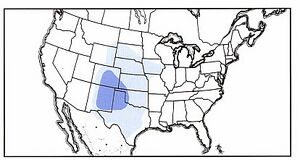
The biogeographic map of the High Plains grasshopper, made by the University of Wyoming, indicates a core region (dark blue) where both nymphs and adults were observed by scouts during the 1934–40 outbreak, and a peripheral zone (pale blue) where only adults were collected. During this period, swarms spread widely from their native habitats.[2]
The High Plains grasshopper feeds on both shortgrasses, such as blue grama and buffalograss, and midgrasses like sand dropseed, needleandthread, and galleta hilaria, with less preference for western wheatgrass. When they move beyond their preferred food plants, either to find new forage or due to crowding, they can harm or destroy most types of range grasses and cultivated crops.[4] Observations in Hawley, Colorado, in 1997 showed nymphs and adults feeding mainly on sand dropseed, occasionally on other grasses or ground litter, without actively seeking specific species. During the dry spring, short green stems of heavily grazed sand dropseed provided accessible food. These grasshoppers typically fed horizontally on low leaves or stubs, raising their bodies when reaching higher leaves, and used their legs to manipulate the plant. They fed efficiently, consuming all green tissue and leaving dry or yellow parts behind.[2]
Land-use change
Pest status
The High Plains grasshopper was regarded as rare until migrating swarms were seen in Colorado in 1890, followed by the first documented outbreak the next year. It is best known for its destructive outbreak from 1934-1940 where at least 23,575,000 acres across five states were affected. The High Plains grasshopper is now recognized as an occasionally damaging member of destructive rangeland assemblages.[4] D. longipennis can damage short grass communities, especially grama and buffalograss. When populations move beyond their preferred food plants in search of new forage or due to crowding, they can harm or destroy most types of range grasses and cultivated crops.[2] In 1994 it was ranked 23rd on the USDA’s list of the 38 most serious “pest” grasshoppers on western rangeland.[5]
Management
No other insect-control effort in the western United States matched the scale, scope, and level of cooperation achieved in the campaign against the High Plains grasshopper from 1937 to 1940. Poison baiting was the primary means of control during this time.[4] For a detailed list of procedures and expenditures in each affected state during this period see the USDA Wakeland report.

The first coordinated effort to control the species using poisoned bait took place in Crowley, Lincoln, and Pueblo Counties, Colorado, in 1921.[4] Today, the High Plains grasshopper may be treated with pesticides if present alongside other outbreaking species.
Outbreaks
For about 25 years after its discovery in 1867, the High Plains grasshopper was viewed as a minor pest. Over the following four decades there were only several small and short-lived outbreaks.[4] One such account described the 1913 New Mexico grasshopper outbreak, as covering 400 to 500 square miles and destroying most prairie grasses, grains, and garden crops. Cattle had to travel long distances for forage, and trains were often stopped when grasshoppers covered the tracks. Vegetation was so heavily consumed that soil depressions were coated with droppings.[6]
The High Plains grasshopper reached major outbreak levels only once, from 1934 to 1940. It began with local infestations in Colorado and New Mexico in 1933 and expanded each year, peaking in 1939 before declining rapidly. During this period, economically significant populations affected at least 23,575,000 acres across five states, Colorado, Kansas, New Mexico, Oklahoma, and Texas.[4]

Adult grasshoppers traveled hundreds of miles, while large bands of nymphs moved across entire counties, prompting costly, large-scale control efforts to protect rangeland forage. Baiting became the primary control strategy starting in 1937 and grew more intensive over the next two years. By 1940, baiting combined with natural factors—such as birds, weather, predators, and parasites—finally brought the outbreak under control. Overall, control efforts during this period cost 2.25 million dollars (over 50 million in 2025). In 1937, the Colorado Legislature sent a memorial to the President, the Secretary of Agriculture, and Congress urging a bill to provide 5 million dollars for controlling grasshoppers, Mormon crickets, and other migratory insects. Ultimately, only 2 million dollars were appropriated under the bill.[4]
An anecdotal account from a rancher, interviewed in 1952, described how adult grasshoppers flew onto his rangeland in El Paso County, Colorado, in the fall of 1937 and caused serious damage. He had to secure other grazing land and purchase 100 tons of hay to replace the forage lost on his winter range. In 1938 he moved his cattle to rangeland in Crowley and Otero Counties, only to have the winter forage there destroyed again. He spent $7,500 on hay to keep his herd through the winter. This did not include the additional costs of locating grasshopper bands and hauling and spreading bait to protect parts of his winter range.[4]
There have been no D. longipennis outbreaks since 1940. From 1940 to 1951, unusually wet weather in the High Plains likely kept populations low, and surveys found only occasional single individuals.[4] This species is only occasionally recorded among rangeland grasshopper communities.[2]
Outbreak media coverage
Associated organizations
No results found in the database at this time—please reach out if you have any to share!
Resources
| Title | Author(s) | Year | Geographic purview | URL |
|---|---|---|---|---|
| Common Grasshoppers of Montana Cropland and Rangeland | Montana State University | View URL | ||
| Grasshoppers of Colorado presentation | University of Colorado | N/A | View URL | |
| The High Plains grasshopper | United States Department of Agriculture,Claude Wakeland | 1958 | View URL | |
| How to control grasshoppers in Oklahoma | Oklahoma State University,Fenton FA | 1937 | View URL | |
| Grasshoppers (Acrididae) of Colorado | Colorado State University,John Capinera,TS Sechrist | 1982 | ||
| A Manual of the Grasshoppers of New Mexico | New Mexico Cooperative Extension Service,D.B. Richman, D.C. Lightfoot, C.A. Sutherland and DJ. Ferguson | 1993 | View URL | |
| Orthoptera of Northern Great Plains | North Dakota State University | 2007 | ||
| The grasshoppers of Nebraska | Animal and Plant Health Inspection Service,Mathew L. Brust, Wyatt Hoback and Robert J. Wright | 2009 | View URL | |
| Field Guide to Common Western Grasshoppers | United States Department of Agriculture,Robert E. Pfadt | 2002 | ||
| Grasshoppers of the Western United States | United States Department of Agriculture | View URL | ||
| ARS grasshopper species fact sheets | Agricultural Research Services and United States Department of Agriculture | 1994 | ||
| The Grasshoppers of the Western U.S. Lucid mobile app | APHIS PPQ Science & Technology Insect Management and Molecular Diagnostics Laboratory (Phoenix Station), United States Department of Agriculture and Center for Plant Health Science and Technology of the USDA | 2016 |
Specimen contributors for this species
 Natural history collections are built by people. The specimens that document this species were collected in the field, preserved in collections, and identified by generations of researchers and naturalists. Bionomia helps make these often-overlooked contributions visible by linking specimen records to the people behind them.
The contributors shown here are drawn from specimen records made available through GBIF and attributed to individuals by Bionomia.
Collected by
These people collected specimens of this species in the field, helping build the physical record of where and when it has occurred.
- David Tan — 3 specimens collected
Identified by
These people examined specimens and determined their taxonomic identity—an essential step in turning a collected specimen into a useful biodiversity record.
- Tyler Grant — 5 specimens identified
- Elliott Gordon — 1 specimen identified
References
- ↑ Johnson DL (n.d.) Band-winged grasshoppers of the Canadian Prairies and Northern Great Plains. Environmental Health, Agriculture and Agri‑Food Canada Research Centre, Lethbridge, AB & University of Lethbridge, Lethbridge, AB, Canada. https://hopperwiki.org/images/0/0d/Band-winged_grasshoppers_of_the_Canadian_Prairies_and_Northern_Great_Plains.pdf
- ↑ 2.00 2.01 2.02 2.03 2.04 2.05 2.06 2.07 2.08 2.09 2.10 2.11 2.12 2.13 2.14 2.15 University of Wyoming (n.d.) Grasshoppers of Wyoming and the West: High Plains grasshopper Dissosteira longipennis (Thomas). Available at: https://www.uwyo.edu/entomology/grasshoppers/field-guide/dilo.html
- ↑ BugGuide contributors (accessed 2025) Species Dissosteira longipennis - High Plains Grasshopper. BugGuide.net: Identification, Images, & Information For Insects, Spiders & Their Kin For the United States & Canada. [1](https://bugguide.net/node/view/356523)
- ↑ 4.00 4.01 4.02 4.03 4.04 4.05 4.06 4.07 4.08 4.09 4.10 4.11 4.12 4.13 4.14 4.15 4.16 Wakeland C (1958) The High Plains grasshopper: a compilation of facts about its occurrence and control. U.S. Department of Agriculture, Washington. https://hopperwiki.org/images/3/3d/The_High_Plains_grasshopper.pdf
- ↑ Dysart RJ (ND) VI.6 Relative Importance of Rangeland Grasshoppers in Western North America: A Numerical Ranking From the Literature. In: Cunningham GL, Sampson MW (Technical Coordinators), Grasshopper Integrated Pest Management User Handbook. United States Department of Agriculture, Animal and Plant Health Inspection Services. https://www.ars.usda.gov/ARSUserFiles/30320505/grasshopper/Extras/PDFs/IPM%20Handbook/VI6.pdf
- ↑ Hinkle G A (1938) The relation of grasshoppers (with special emphasis on Dissosteira longipennis, Thomas) to the native ranges of Colorado. Colorado Agricultural Bibliography.