United States Rangeland Management Community Portal

The Rangeland Community Management Portal is a comprehensive hub created by ASU's Global Locust Initiative and APHIS's Insect Management and Molecular Diagnostics Laboratory in Arizona to support land managers, researchers, and community members in understanding and addressing rangeland grasshopper and Mormon cricket management.

The portal features an interactive map that allows users to navigate directly to state-specific pages, each enriched with local information on species and regionally relevant resources. Detailed species profiles that highlight the biology, ecology, and management of the top U.S. rangeland pests. Covering 17 western states—Arizona, California, Colorado, Idaho, Kansas, Montana, Nebraska, Nevada, New Mexico, North Dakota, Oklahoma, Oregon, South Dakota, Texas, Utah, Washington, and Wyoming—the portal emphasizes the ecological and economic importance of these native insects. While grasshoppers and Mormon crickets are integral to rangeland ecosystems, under favorable conditions their populations can explode to outbreak levels, directly competing with livestock for forage. A swarm of grasshoppers equivalent to 30 pounds can consume as much forage as a 600-pound steer, rapidly depleting the most desirable plant species and straining rangeland resources, particularly during drought.
By combining scientific knowledge, management information, and locally relevant insights, the Rangeland Community Management Portal helps equips stakeholders with the tools they need to understand grasshopper outbreaks—helping protect both rangeland productivity and rural livelihoods.
Navigate to state resources
Significant grasshopper species in the United States



Species of management concern in the United States
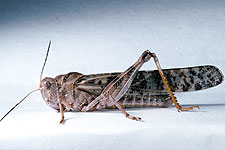
Rangeland grasshoppers are ground-dwelling insects with powerful hind legs for leaping and, in many species, wings that enable long-distance flight. They are sometimes called short-horned grasshoppers to distinguish them from katydids, which have notably longer antennae. Unlike grasshoppers, Mormon crickets are flightless katydids. However, they can travel vast distances by walking or jumping, often migrating in massive groups numbering in the millions or even billions. The Mormon cricket is the only katydid species in the U.S. known to form outbreak populations. [1]
Large outbreaks of grasshoppers and Mormon crickets occur roughly every decade, though local populations fluctuate based on environmental conditions and other factors. Check the National Drought Mitigation Center or the Drought Mitigation Map for U.S. drought conditions .
When a prompt response to a developing grasshopper outbreak is required, a Federal agency or a State agriculture department (on behalf of a State, a tribe, a local government, or a private group or individual) may request assistance from the United States Department of Agriculture’s (USDA) Animal and Plant Health Inspection Service (APHIS) to suppress rangeland grasshopper populations in the 17 Western States.
The objectives of the PHIS Rangeland Grasshopper and Mormon Cricket Suppression Program are to 1) conduct surveys of grasshopper populations in 17 Western States; 2) provide technical assistance to land managers; and 3) when requests are made and funds permit, suppress economically damaging grasshopper and Mormon cricket outbreaks on Federal, Tribal, State, and private rangeland. [2] APHIS evaluates several factors to decide whether grasshopper suppression is necessary, including the pest species involved, the maturity of the pest population, the timing of treatment, the cost-effectiveness of the action, and ecological impacts.
Historically, poisoning was the primary method for controlling grasshoppers on cultivated lands, mainly targeting the Melanoplus and Schistocerca. Poison bait formulas were commonly made using bran, sawdust, liquid sodium arsenite (arsenic), and water. Another widely used bait, effective against other pests like cutworms and crickets, consists of bran, white arsenic or other toxic agents, water, and optional molasses or citrus additives for increased attractiveness. [3]
Today, chemical insecticides remain a primary tool for managing grasshopper populations. APHIS has been actively involved in treating millions of acres across Western states to suppress grasshopper outbreaks. Carbaryl and malathion are widely used insecticides effective against grasshoppers. Diflubenzuron is also used at times and is an insect growth regulator.
HopperWiki species of concern classification
IMMDL top 12
The APHIS Insect Management and Molecular Diagnostics Laboratory in Arizona considers the above 12 grasshoppers, plus the Mormon cricket, to be the top species of management concern in the Western United States. Informally they are refered to as the "dirty dozen" and are classified in HopperWiki as "IMMDL top 12".
APHIS rangeland priority pest
The other tag "APHIS rangeland priority pest" is used to represent a wider list of grasshopper pest species that were cited in the USDA numerical ranking report by Richard Dysart. He reviewed 69 scientific papers published between 1924 and 1993, gathering expert opinions on the pest status of 377 grasshopper species. Each mention of a species in a paper was categorized as a serious pest, minor pest, innocuous, possibly beneficial, or beneficial, resulting in 2,731 total rankings.
To compare species, Dysart assigned point values to each category—serious (+2), minor (+1), innocuous (0), possibly beneficial (–1), and beneficial (–2)—and calculated a total score for each species by multiplying the number of mentions in each category by its point value. Species with higher total scores were ranked as more harmful, while those with lower or negative scores were considered neutral or beneficial. In cases of tied scores, the species more frequently cited as a serious or minor pest was given a higher rank.
No results found. If you have expertise or materials on this topic that you are willing to contribute, please get in touch with an administrator.
Featured identification guides




Featured regulatory documents


Identification resources in the United States
| Name | Year published | Resource link | Language | Author | Year published |
|---|---|---|---|---|---|
| A Manual of the Grasshoppers of New Mexico | 1993 | View | English | New Mexico Cooperative Extension Service, D.B. Richman, D.C. Lightfoot, C.A. Sutherland, DJ. Ferguson | 1993 |
| ARS grasshopper species fact sheets | 1994 | English | Agricultural Research Services, United States Department of Agriculture | 1994 | |
| Common Grasshoppers of Montana Cropland and Rangeland | View | English | Montana State University | ||
| Common Wyoming pest grasshoppers | View | English | University of Wyoming, Scott Schell, Alexandre Latchininsky, B.A. Shambaugh | ||
| Community-wide grasshopper control | 2020 | View | English | Utah State University, Marion Murray | 2020 |
| Crickets and grasshoppers in Utah | 1931 | View | English | Utah State University | 1931 |
| Differentiation, ecology, and distribution of immature slant-faced grasshoppers (Acridinae) in Kansas | 1967 | View | English | Kansas State University, Merlyn A. Brusven | 1967 |
| Eastern lubber grasshopper | 2025 | English | University of Wisconsin-Milwaukee | 2025 | |
| Field Guide to Common Western Grasshoppers | 2002 | English | United States Department of Agriculture, Robert E. Pfadt | 2002 | |
| Field guide to grasshoppers of economic importance in Nevada | View | English | University of Nevada | ||
| Field guide to some of the common grasshoppers of the Front Range of Colorado | View | English | University of Colorado | ||
| Grasshopper control in gardens and small acreages | 2013 | View | English | Colorado State University, W.S. Cranshaw, R. Hammon | 2013 |
| Grasshopper investigations on Montana rangelands | 1952 | View | English | Montana State University, Norman L. Anderson, John C. Wright | 1952 |
| Grasshoppers (Acrididae) of Colorado | 1982 | English | Colorado State University, John Capinera, TS Sechrist | 1982 | |
| Grasshoppers and their control | View | English | Texas A&M University, Carl D. Patrick | ||
| Grasshoppers of the Choctaw Nation in Southeast Oklahoma | 2021 | View | English | Alex J. Harman, W. Wyatt Hoback, Tom A. Royer | 2021 |
| Grasshoppers of the Western United States | View | English | United States Department of Agriculture | ||
| Grasshoppers their habits and damage | 1964 | View | English | United States Department of Agriculture | 1964 |
| Hopper helper | View | English | Wendal Cushing | ||
| Idaho Grasshopper and Mormon Cricket Control Program | English | ||||
| Identification guides for pest grasshoppers in Nebraska | 2009 | English | Institute of Agriculture and Natural Resources, Ron Seymour, Gary Hein, Jack Campbell, Jim Kalisch | 2009 | |
| iNaturalist | View | English | |||
| Insect answers | 1990 | View | English | Daniel Suomi, Gary Thomasson, Dave Keim | 1990 |
| Key to Wyoming grasshoppers | English | University of Wyoming, Timothy J. McNary | |||
| Montana.gov Orthoptera Field Guides | View | English | |||
| Mormon cricket biology and management poster | View | English | University of Wyoming, APHIS Plant Protection and Quarantine | ||
| Orthoptera of Northern Great Plains | 2007 | English | North Dakota State University | 2007 | |
| Pacific Northwest Pest Management Handbook | English | ||||
| Pest grasshoppers in Oregon | 2024 | View | English | Oregon Department of Agriculture, Thomas Valente, J. Buck Dunlap | 2024 |
| Pest Grasshoppers of the West | 2005 | View | English | University of Wyoming | 2005 |
| Rangeland Grasshopper Management | 1993 | English | University of Wyoming, Jeffrey Lockwood, Scott Schell | 1993 | |
| Singing Insects of North America | View | English | |||
| The banded-wing grasshoppers of Idaho | 1967 | View | English | George B. Hewitt, William F. Barr | 1967 |
| The grasshoppers and other orthoptera of Arizona | 1942 | View | English | University of Arizona, E. Ball, E. R. Tinkham, Robert Flock, C. T. Vorhies | 1942 |
| The grasshoppers of Kansas, part I | 1915 | View | English | University of Kansas, P.W. Claassen | 1915 |
| The grasshoppers of Nebraska | 2009 | View | English | Animal and Plant Health Inspection Service, Mathew L. Brust, Wyatt Hoback, Robert J. Wright | 2009 |
| The Grasshoppers of the Western U.S. Lucid mobile app | 2016 | English | APHIS PPQ Science & Technology Insect Management and Molecular Diagnostics Laboratory (Phoenix Station), United States Department of Agriculture, Center for Plant Health Science and Technology of the USDA | 2016 | |
| The more destructive grasshoppers of Kansas | 1897 | View | English | University of Kansas, J.S. Parks | 1897 |
| The Orthoptera of Michigan | 2003 | View | English | Roger G. Bland | 2003 |
| UofA School & Home Integrated Pest Management (IPM) Newsletter Newsletter Grasshoppers | 2023 | View | English | University of Arizona, Dawn H. Gouge, Tom J. Getts, Tim W. Stock, John F. Connett, Micah Gay | 2023 |
| Utah pests fact sheet | 2008 | View | English | Utah State University, Edward W. Evans, Erin W. Hodgson | 2008 |
APHIS historical grasshopper archives
USDA’s wealth of resources, accumulated over decades in filing cabinets and hard drives, has previously been difficult for stakeholders to access or use effectively. Through this collaboration between ASU's Global Locust Initiative and APHIS's Insect Management and Molecular Diagnostics Laboratory in Arizona, those materials have been curated and integrated into the portal below where you can filter and view documents by keyword themes. The documents on this portal include records of grasshopper population surveys, outbreak maps, descriptions of control efforts, impact assessments, and reports from trials and experiments with different management approaches. Together, these materials illustrate both the scale of the problem and the ongoing search for effective, sustainable strategies in grasshopper management across western rangelands.
Access the archive interface HERE or by clicking on the image below. You will need to create a free account with Airtable if view the data. If you need any assistance please reach out to [email protected]

The Rangeland Community Management Portal is a collaborative effort between ASU's Global Locust Initiative and APHIS's Insect Management and Molecular Diagnostics Laboratory in Arizona. This collaboration is developing an interactive resource that connects users to biological and management information for the top pest grasshopper species in the western United States.
References
- ↑ United States Department of Agriculture. (n.d.). Rangeland grasshopper and Mormon cricket management. U.S. Department of Agriculture, Animal and Plant Health Inspection Service. Retrieved [date], from https://www.aphis.usda.gov/plant-pests-diseases/ghmc
- ↑ U.S. Department of Agriculture (USDA), Animal and Plant Health Inspection Service (APHIS). (n.d.). Rangeland grasshopper and Mormon cricket program: Final environmental impact statement. Retrieved February 17, 2025, from https://www.aphis.usda.gov/sites/default/files/rangeland-grasshopper-mormon-cricket-program-final-eis.pdf
- ↑ Ball E, Tinkham E, Flock R, Vorhies C (1942) The Grasshoppers and Other Orthoptera of Arizona. College of Agriculture, University of Arizona (Tucson, AZ), The University of Arizona. Available from: https://repository.arizona.edu/handle/10150/190516 (February 18, 2025).