Striped grasshopper (Amphitornus coloradus)
| Amphitornus coloradus | |
|---|---|
 | |
| Other common names | |
| Striped slantfaced grasshopper | |
| Taxonomic classification | |
| Suborder: | Caelifera |
| Family: | Acrididae |
| Subfamily: | Gomphocerinae |
| Tribe: | Eritettigini |
| Genus: | Amphitornus |
| Scientific name | |
| Amphitornus coloradus (Thomas, 1873) | |
| Geography | |
| Native countries: | |
| Pest status | |
| Known pest | |
The striped grasshopper (Amphitornus coloradus) is an early-hatching species found in western North American prairies, where it feeds mainly on grasses like blue grama. It develops slowly and remains mostly sedentary. They are often part of an assemblage of other rangeland grasshopper species during outbreaks.
Taxonomy
For full nomenclature and taxonomic details of this taxon, see Orthoptera Species File
Identification
The striped grasshopper is a species of slant-faced grasshopper in the family Acrididae. Slant-faced grasshoppers are recognized by their angled facial profile and typically slender, streamlined bodies with forward-tipped, pointed heads. Most slant-faced grasshoppers in North America belong to the subfamily Gomphocerinae, commonly known as “stridulating slant-faced grasshoppers” or “tooth-legged grasshoppers”, named for the row of pegs on the inner hind legs of males used to produce sound by rubbing against the wing edges. A smaller group with similar facial structure, the Acridinae, or “silent slant-faced grasshoppers”, lacks these pegs and does not produce sound. These silent forms are found in some parts of the United States but are absent from western Canadian grasslands.
The striped grasshopper belongs to Gomphocerinae. Members of this subfamily can be readily distinguished from other grasshopper groups: they lack the prosternal spine found in Melanoplinae and the large, colorful, lobed hind wings typical of Oedipodinae.[1] They also differ behaviorally and morphologically from Acridinae.
A few specialized anatomical terms are useful for identifying grasshoppers in this subfamily. Grasshoppers have four wings, with the leathery, protective front pair known as the tegmina. Just behind the head lies the pronotum, a saddle-shaped structure forming the upper part (notum) of the prothorax, the front segment of the thorax. Along the center of the pronotum runs the median carina, a raised ridge, which may be intersected by sulci. At the tip of the head, a central dent called the fastigium may be seen, flanked by lateral foveolae, shallow pits bordered by small ridges. These features, often visible with a hand lens, are key to distinguishing between closely related species within the subfamily.[1]
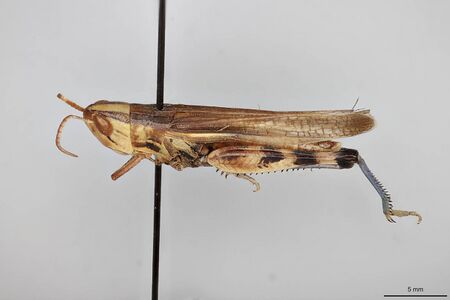
Amphitornus coloradus is medium-sized with bold stripes and can appear brown, black, beige, yellowish-brown, or green. It has a clearly slanted head and long stripes of brown, gray, and dull gold running down its body. Two dark stripes start at the top of the head and fade across the forewings. Its antennae may look slightly sword-shaped or thread-like. The back legs are brown on the upper half and yellow on the lower half, with two dark bands and a black joint where the leg bends. The lower legs are blue. Nymphs also have slanted heads and striped patterns across their heads and bodies.
The bright blue hind tibiae help distinguish this species from similar ones like Eritettix and Opeia, which rarely show the pale dorsal stripe. Opeia has more parallel pronotal sides, while Eritettix typically has a noticeable inward pinch. A. coloradus is generally larger than these species in the same region. Though the Montezuma grasshopper (Syrbula montezuma) may look similar, it is more slender with dark hind wings. Other Syrbula species tend to be larger, differently patterned, with tapered pronotal sides and non-blue tibiae. Amblytropidia species may also resemble it, but they are smaller, duller, with brown tibiae and a more rounded fastigium.[2]
Identification details
.jpg)
Adults of this species are medium-sized, richly striped, and appear brown, black, or beige.[3] They are also reported as yellowish-brown or green.[4] This species can be identified by its distinctly slanted head and the brown, gray, and muted gold stripes running lengthwise along its body.[5]
Two prominent dark stripes begin at the top of the head and gradually widen and fade across the forewings.[4] The lateral foveolae is shallow and not visible.[5] Some say the antennae are slightly sword shaped[6] while others report them as thread-like.[5] The outer surface of the hind femur is brown on the upper half and yellow on the lower half.[7] There are two dark bands on the outer side of the femora, and the junction of the femur and tibia is black.[4] The hind tibiae is blue.[5]
Nymphs of this species can also be identified by the slanted structure of their heads. Additionally, their bodies have stripes that slant and cross along sutures found on their heads.[7]
Featured identification resources


All identification resources
| Title | Author(s) | Year | Geographic purview | URL |
|---|---|---|---|---|
| Common Grasshoppers of Montana Cropland and Rangeland | Montana State University | View URL | ||
| A Manual of the Grasshoppers of New Mexico | New Mexico Cooperative Extension Service,D.B. Richman, D.C. Lightfoot, C.A. Sutherland and DJ. Ferguson | 1993 | View URL | |
| Grasshopper investigations on Montana rangelands | Montana State University,Norman L. Anderson and John C. Wright | 1952 | View URL | |
| Differentiation, ecology, and distribution of immature slant-faced grasshoppers (Acridinae) in Kansas | Kansas State University,Merlyn A. Brusven | 1967 | View URL | |
| Orthoptera of Northern Great Plains | North Dakota State University | 2007 | ||
| Hopper helper | Wendal Cushing | View URL | ||
| The grasshoppers of Nebraska | Animal and Plant Health Inspection Service,Mathew L. Brust, Wyatt Hoback and Robert J. Wright | 2009 | View URL | |
| Common Wyoming pest grasshoppers | University of Wyoming,Scott Schell and Alexandre Latchininsky,B.A. Shambaugh | View URL | ||
| Montana.gov Orthoptera Field Guides | View URL | |||
| Field Guide to Common Western Grasshoppers | United States Department of Agriculture,Robert E. Pfadt | 2002 | ||
| Grasshoppers of the Western United States | United States Department of Agriculture | View URL | ||
| ARS grasshopper species fact sheets | Agricultural Research Services and United States Department of Agriculture | 1994 | ||
| The Grasshoppers of the Western U.S. Lucid mobile app | APHIS PPQ Science & Technology Insect Management and Molecular Diagnostics Laboratory (Phoenix Station), United States Department of Agriculture and Center for Plant Health Science and Technology of the USDA | 2016 | ||
| Rangeland Grasshopper Management | University of Wyoming,Jeffrey Lockwood and Scott Schell | 1993 |
Distribution
Occurs across the western United States and Canada, primarily west of the Mississippi River.[4] Common on rangelands of Wyoming, where it has the potential to cause severe forage loss.[6]
A. coloradus has been observed at elevations up to 11,400 ft in Colorado, though adults at these heights cannot complete their life cycle. Populations found at lower elevations, around 5,400 ft, may serve as breeding sources for individuals that disperse to higher, less viable altitudes.[6]
Biology and ecology
The striped grasshopper hatches early in the season, with embryos pausing development over winter and completing it as soil warms in spring. Nymphs take 50–56 days to reach adulthood, slower than related species, likely due to spending more time above ground on vegetation. Adults appear from July to September.[4] Adults stay in their natal habitat, where green host plants and daily predator pressure shape their behavior. Courtship is rare and brief. Females lay eggs in sedge or grass bases, embedding small, soil-camouflaged pods below the surface. With one generation per year, this species' life cycle is tightly linked to temperature and habitat structure.[6] [3]
A. coloradus are strong fliers with long wings, capable of fast, silent evasive flights just 2–6 inches above ground for 2–7 feet, often landing in a zigzag pattern. While adults can disperse, they don’t form migratory swarms. Nymphs remain near their hatching sites if food is available.[6] [3]
Photos of this species
-

Amphitornus coloradus -

Amphitornus coloradus -

Amphitornus coloradus -

Amphitornus coloradus -

Amphitornus coloradus -

Amphitornus coloradus -
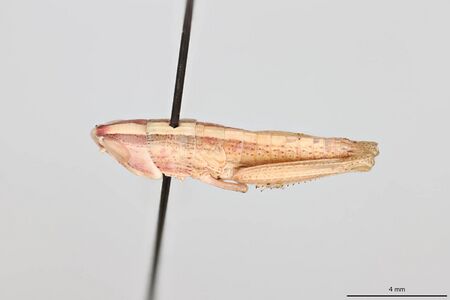
Amphitornus coloradus -

Amphitornus coloradus -

Amphitornus coloradus -

Amphitornus coloradus -
Amphitornus coloradus


Habitat and ecology
A. coloradus is a mostly graminivorous species often present in areas with short or sparse vegetation. [4] It is typically found at the base of grass clumps, closely associated with areas of open sand and plant litter. [8] The plant litter likely is because A. coloradus climbs plants and cuts leaves, often holding them with its front tarsi. While most cut material is eaten, some may fall and be consumed by others or become litter and often unavailable for livestock to consume. [6]
This species feeds primarily on blue grama, needleandthread, and threadleaf and needleleaf sedges. Crop analysis also reveals consumption of 17 other grasses, including key rangeland forages like western wheatgrass, prairie junegrass, Sandberg bluegrass, and sand dropseed. [6] It will feed on dead or very dry foliage. [9]
Land-Use Change
Populations of A. coloradus have incrementally increased in the Canadian Prairies since 1998, though population numbers have not reached the economic threshold throughout the Canadian range. With predicted warmer temperatures due to climate change, A. coloradus populations may have the potential to cause economic damage in Canada.[5]
Pest status
The striped grasshopper is one of the top dozen species monitored by USDA Animal and Plant Health Inspection Service (APHIS) because of its impact on rangelands. While it is rarely the dominant species found on rangelands, it is often part of a complex and among the top three abundant species infesting the area. [10][6] Their populations usually grow gradually over several years, then spike sharply, tripling or quadrupling in a single year, often alongside other pest outbreaks. By late summer, natural mortality typically causes their numbers to crash.[3]
Management
The main strategy for managing grasshopper outbreaks on rangelands in the United States involves the use of insecticides applied via all-terrain vehicle (ATV)-mounted or aerial sprayers. Recommended insecticides include diflubenzuron, malathion, chlorantraniliprole, various pyrethroids, and carbaryl. Applications are made either through full-area coverage or using a method known as Reduced Agent and Area Treatments (RAATs). RAATs are an integrated pest management (IPM) technique where insecticide rates are lowered from standard levels, and treated swaths are alternated with untreated ones, reducing total coverage to 50% or less. This method combines direct chemical control (killing grasshoppers in treated areas and as they migrate from untreated zones) with conservation biological control, allowing natural enemies in untreated areas to help suppress the population. This IPM strategy can cut both insecticide use and treatment costs by more than half. Control efforts typically achieve around 80% effectiveness, which is adequate to suppress most grasshopper populations. The insect growth regulator diflubenzuron has shown particular success in RAAT applications due to its long-lasting residual toxicity, which persists for about three weeks.[11][12][13]
Outbreaks
Outbreak media coverage
Associated organizations
No results found in the database at this time—please reach out if you have any to share!
Resources
| Title | Author(s) | Year | Geographic purview | URL |
|---|---|---|---|---|
| Common Grasshoppers of Montana Cropland and Rangeland | Montana State University | View URL | ||
| A Manual of the Grasshoppers of New Mexico | New Mexico Cooperative Extension Service,D.B. Richman, D.C. Lightfoot, C.A. Sutherland and DJ. Ferguson | 1993 | View URL | |
| Grasshopper investigations on Montana rangelands | Montana State University,Norman L. Anderson and John C. Wright | 1952 | View URL | |
| Differentiation, ecology, and distribution of immature slant-faced grasshoppers (Acridinae) in Kansas | Kansas State University,Merlyn A. Brusven | 1967 | View URL | |
| Orthoptera of Northern Great Plains | North Dakota State University | 2007 | ||
| Hopper helper | Wendal Cushing | View URL | ||
| The grasshoppers of Nebraska | Animal and Plant Health Inspection Service,Mathew L. Brust, Wyatt Hoback and Robert J. Wright | 2009 | View URL | |
| Common Wyoming pest grasshoppers | University of Wyoming,Scott Schell and Alexandre Latchininsky,B.A. Shambaugh | View URL | ||
| Montana.gov Orthoptera Field Guides | View URL | |||
| Field Guide to Common Western Grasshoppers | United States Department of Agriculture,Robert E. Pfadt | 2002 | ||
| Grasshoppers of the Western United States | United States Department of Agriculture | View URL | ||
| ARS grasshopper species fact sheets | Agricultural Research Services and United States Department of Agriculture | 1994 | ||
| The Grasshoppers of the Western U.S. Lucid mobile app | APHIS PPQ Science & Technology Insect Management and Molecular Diagnostics Laboratory (Phoenix Station), United States Department of Agriculture and Center for Plant Health Science and Technology of the USDA | 2016 | ||
| Rangeland Grasshopper Management | University of Wyoming,Jeffrey Lockwood and Scott Schell | 1993 |
Specimen contributors for this species
 Bionomia links specimen records in GBIF to the people who collected and identified them. Each list shows the top 20 for this species.
Collected by
People who collected specimens of this species in the field.
- Charles Hart — 2 specimens collected
Identified by
People who determined the taxonomic identity of specimens of this species.
- Tyler Grant — 5 specimens identified
References
- ↑ 1.0 1.1 Johnson DL (n.d.) Slant-faced grasshoppers of the Canadian Prairies and Northern Great Plains. Environmental Health, Agriculture and Agri‑Food Canada Research Centre, Lethbridge, AB & University of Lethbridge, Lethbridge, AB, Canada. https://hopperwiki.org/images/5/5b/Slant-faced_grasshoppers_of_the_Canadian_Prairies_and_Northern_Great_Plains.pdf
- ↑ BugGuide (n.d.) Amphitornus coloradus – Striped slant-face grasshopper. Iowa State University. https://bugguide.net/node/view/197438
- ↑ 3.0 3.1 3.2 3.3 Schell SP, Latchininsky AV, Shambaugh BA (2004) Common Wyoming pest grasshoppers. University of Wyoming Cooperative Extension Service Bulletin B-1161, 24 pp. https://www.wyoextension.org/agpubs/pubs/B1161.pdf
- ↑ 4.0 4.1 4.2 4.3 4.4 4.5 Capinera JL, Scott RD, Walker TJ (2005) Field guide to grasshoppers, katydids, and crickets of the United States. Cornell University Press, Ithaca, New York, 280 pp.
- ↑ 5.0 5.1 5.2 5.3 5.4 Johnson DL (2003) Slant-faced grasshoppers of the Canadian Prairies and Northern Great Plains. Arthropods of Canadian Grasslands 9: 5–16. Biological Survey of Canada, Ottawa. https://www.ars.usda.gov/ARSUserFiles/30320505/grasshopper/ID%20Tools/naturalist%20guides/sltgh.pdf
- ↑ 6.0 6.1 6.2 6.3 6.4 6.5 6.6 6.7 Pfadt RE (1994) Striped Grasshopper 'Amphitornus coloradus' (Thomas). Wyoming Agricultural Experiment Station Bulletin 912. Species Fact Sheet. https://www.ars.usda.gov/ARSUserFiles/30320505/grasshopper/Extras/PDFs/Species%20Fact%20Sheets/Striped.pdf
- ↑ 7.0 7.1 North Dakota State University (n.d.) Amphitornus coloradus (Thomas) – Striped Grasshopper. Orthoptera of the Northern Great Plains. https://www.ndsu.edu/ndmoths/hopper/index/amphitornus_coloradus.htm
- ↑ Fuller R, Joern A (1996) Grasshopper susceptibility to predation in response to vegetation cover and patch area. Journal of Orthoptera Research 5: 175–183. https://doi.org/10.2307/3503592
- ↑ Joern A, Mitschler R, O'Leary H (1986) Activity and time budgets of three grasshopper species (Orthoptera: Acrididae) from a Sandhills grassland. Journal of the Kansas Entomological Society 59: 1–6. https://www.jstor.org/stable/25084728
- ↑ Anderson NL (1973) The vegetation of rangeland sites associated with some grasshopper studies in Montana. Montana Agricultural Experiment Station, Montana State University. https://babel.hathitrust.org/cgi/pt?id=uiug.30112019698999
- ↑ Latchininsky A (2019) In: Lecoq M, Zhang L (Eds) Encyclopedia of pest Orthoptera of the world. China Agricultural University Press, Beijing, China, pp. 9, 23, 53, 136, 141, 145, 151.
- ↑ Latchininsky AV, Schell SP (2007) Aerial RAATs brochure. ATV-RAATs brochure. UW CES Bulletin MP-95, Laramie, WY, USA.https://hopperwiki.org/index.php/UWYO_information_on_reduced_agent_and_area_treatments_(RAATs)
- ↑ Lockwood JA, Schell SP (1997) Decreasing economic and environmental costs through reduced area and agent insecticide treatments (RAATs) for the control of rangeland grasshoppers: empirical results and their implications for pest management. Journal of Orthoptera Research 6: 19–32.