White cross grasshopper (Aulocara femoratum)
| Aulocara femoratum | |
|---|---|
 | |
| Other common names | |
| Whitecrossed grasshopper, White-crossed grasshopper | |
| Taxonomic classification | |
| Suborder: | Caelifera |
| Family: | Acrididae |
| Subfamily: | Gomphocerinae |
| Tribe: | Aulocarini |
| Genus: | Aulocara |
| Scientific name | |
| Aulocara femoratum Scudder, 1899 | |
| Synonyms: | Drepanoterna femoratum |
| Geography | |
| Native countries: | |
| Pest status | |
| Known pest | |
The white cross grasshopper (Aulocara femoratum) is found widely through the western grasslands. It has the potential to be dominant in outbreaks and destructive to rangelands in the United States.
Taxonomy
For full nomenclature and taxonomic details of this taxon, see Orthoptera Species File
Identification
Aulocara femoratum is a species of slant-faced grasshopper in the family Acrididae. Slant-faced grasshoppers are recognized by their angled facial profile and typically slender, streamlined bodies with forward-tipped, pointed heads. Most slant-faced grasshoppers in North America belong to the subfamily Gomphocerinae, commonly known as “stridulating slant-faced grasshoppers” or “tooth-legged grasshoppers,” named for the row of pegs on the inner hind legs of males used to produce sound by rubbing against the wing edges. A smaller group with similar facial structure, the Acridinae, or “silent slant-faced grasshoppers”, lacks these pegs and does not produce sound. These silent forms are found in some parts of the United States but are absent from western Canadian grasslands.
The white cross grasshopper belongs to Gomphocerinae. Members of this subfamily can be readily distinguished from other grasshopper groups: they lack the prosternal spine found in Melanoplinae and the large, colorful, lobed hind wings typical of Oedipodinae.[1] They also differ behaviorally and morphologically from Acridinae.
A few specialized anatomical terms are useful for identifying grasshoppers in this subfamily. Grasshoppers have four wings, with the leathery, protective front pair known as the tegmina. Just behind the head lies the pronotum, a saddle-shaped structure forming the upper part (notum) of the prothorax, the front segment of the thorax. Along the center of the pronotum runs the median carina, a raised ridge, which may be intersected by sulci. At the tip of the head, a central dent called the fastigium may be seen, flanked by lateral foveolae, shallow pits bordered by small ridges. These features, often visible with a hand lens, are key to distinguishing between closely related species within the subfamily.[1]
The white cross grasshopper is easy to recognize by the dark "X" shape on its back. It has a large head with a dark streak above the mouth, and its body is usually gray-brown, beige, or yellowish with darker markings. Its wings are normally short, just reaching the tip of the body, though some may have longer ones. The hind wings are clear, and the belly is yellowish. It has thin antennae, a rounded head, and brown front wings with dark spots. Its back legs are cream-colored with three dark bands, and the lower legs are blue. Nymphs are shades of brown, tan, and cream, with dark markings and a stripe on the head. As they grow, their back legs change color from gray to light blue.
Identification details
The white cross grasshopper has a large head, with a dark streak running vertically above the mandible. Notably, the pronotum disk is dark, with four white lines that form an X on the dorsal side.[2][3] Generally adults are gray-brown [4], brownish-yellow or beige, with gray-brown markings.[5][3] They have thin antennae and a rounded vertex.[6]
This species usually has short wings, just barely reaching the end of the abdomen, though a rare few may have longer wings that reach past the abdomen.[2] Specifically, adult males may have forewings that land just short of the abdomen, a characteristic that is more variable in females. The hind wings are clear, and the abdomen is mostly a yellowish color.[4] Their lateral lobe of the pronotum contains a patch that is dark or black. The tegmina of this species are opaque brown and speckled with dark spots.[6] The veins found on the tegmina are bunched together.[6] Adults of this species have cream colored hind femurs, accented with three dark bands, while the hind tibiae are blue[3], may range towards purple, with a black base.[7]
A. femoratum nymphs are generally colored in various hues of brown, tan and cream.[5] They have a moderately slanted face and head, the lateral foveolae are four-sided and noticeable from above.[2] They are generally a light tan or cream color, with various striking markings. The top of the head is light tan, marked with a dark brown stripe that runs down the middle. This fuscous strip is broken by a thin light tan line. The lateral lobes of the pronotum are fuscous in color at the tip and light tan or cream dorsally.[2] As nymphs develop into adults, the hind tibia changes colors from gray to light blue.[5] Female nymphs develop a cleft located on the eighth abdominal sternum during their fourth and fifth instars.[2] This cleft can also be found in female adults.[2]
Featured identification resources

All identification resources
| Title | Author(s) | Year | Geographic purview | URL |
|---|---|---|---|---|
| Common Grasshoppers of Montana Cropland and Rangeland | Montana State University | View URL | ||
| Grasshoppers (Acrididae) of Colorado | Colorado State University,John Capinera,TS Sechrist | 1982 | ||
| A Manual of the Grasshoppers of New Mexico | New Mexico Cooperative Extension Service,D.B. Richman, D.C. Lightfoot, C.A. Sutherland and DJ. Ferguson | 1993 | View URL | |
| Orthoptera of Northern Great Plains | North Dakota State University | 2007 | ||
| The grasshoppers of Nebraska | Animal and Plant Health Inspection Service,Mathew L. Brust, Wyatt Hoback and Robert J. Wright | 2009 | View URL | |
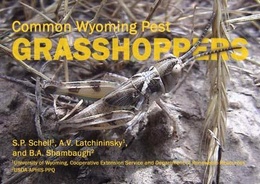
| Common Wyoming pest grasshoppers | University of Wyoming,Scott Schell and Alexandre Latchininsky,B.A. Shambaugh | View URL | ||
| Montana.gov Orthoptera Field Guides | View URL | |||
| Field Guide to Common Western Grasshoppers | United States Department of Agriculture,Robert E. Pfadt | 2002 | ||
| Grasshoppers of the Western United States | United States Department of Agriculture | View URL | ||
| ARS grasshopper species fact sheets | Agricultural Research Services and United States Department of Agriculture | 1994 | ||
| The Grasshoppers of the Western U.S. Lucid mobile app | APHIS PPQ Science & Technology Insect Management and Molecular Diagnostics Laboratory (Phoenix Station), United States Department of Agriculture and Center for Plant Health Science and Technology of the USDA | 2016 |
Distribution
The white cross grasshopper is primarily found in shortgrass prairies from Alberta to Texas, with its range concentrated east of the Rocky Mountains. [8] It is widely distributed across western North America, especially in the rangelands of the Northern Plains. [9] Its range extends from southern Canada (Alberta and Saskatchewan) to northern Mexico [10], reaching westward to the edge of the Great Plains but occurring only infrequently west of the Rockies. [3]
The white cross grasshopper is more abundant in Montana than in Wyoming.[2] It is considered a major pest in Nebraska,[9] and ranks among the three most important rangeland grasshopper species in Arizona.[7] In Colorado, populations inhabit a variety of habitats, from the plains to the mountain foothills in the eastern part of the state.[10] They are also found in eroded river valleys, including the Milk, Lost, and Frenchman rivers.[7] In Wyoming, this species occurs in the eastern grasslands at elevations below 7,000 feet.[5]
Biology
The white-crossed grasshopper is a species that hatches in the middle of the season, usually near the end of spring.[10][5] Hatching takes about two weeks,[5] peaking in early June.[5] Nymphs may start to appear in early June[2] though they are more commonly seen from mid-July through October.[10] Nymphs are usually seen from spring into summer, while adults typically show up from early July to August[4] or also reported from June to October.[3]
Male nymphs experience four nymphal instars and take 30 days to complete development. Due to their larger body size than males, female nymphs experience five nymphal instars and take at least 30[9] to 42 days to complete development.[2] Adults take around 3 weeks to completely development.[9] Adults stay within the environments they hatched as nymphs in[2], especially when densities remain low, around 0.1 - 2 individuals per yard.[9] Male white cross grasshopper fledge before the females, and mating occurs around three weeks after the fledging of the females.[2] The white cross grasshopper may take flight to escape when threatened. Its flight is silent, and it typically lands facing away from the source of danger. Evasive flights usually cover a distance of about 2 to 6 feet and reach heights of 4 to 10 inches. [2] Although these grasshoppers are not known to move in bands, they commonly disperse in search of food when resources become scarce in their habitat. [5]
Males stridulate during courtship but don't produce a typical stridulation sound.[2] There may be a ticking sound along with the jolts of vibration.[7] It is suspected that female white cross grasshoppers may view this movement as cue for mating or they may be hearing courtship sounds undetectable by humans.[2] When males are mounted, touched or approached by other males, they may produce quiet ticking sounds by continuously moving their femora upwards rapidly.[8]
The white cross grasshopper overwinters during their egg stage and produces one generation annually. Females require time for eggs to develop post mating, before oviposition.[9] Females then locate a small, remote, patch of land, around 1-6 square inches, to oviposit. This area is surrounded by blue grama plants or other short grasses, to ensure eggs are sheltered and nymphs have sources for food nearby upon hatching. Egg pods are durable, with thick walls that contain nine to eleven eggs.[2]
Photos of this species
No images found for this query -- should be coming soon!
Habitat and ecology
The white cross grasshopper inhabits mixedgrass, bunchgrass, shortgrass, desert prairies, and other western grasslands with clay soils and sparse vegetation.[9][2][7][3] As a geophilous insect, the white cross grasshopper spends most of its time on the ground, both day and night. Rather than seeking shelter under vegetation or canopy cover, it prefers open areas with scattered vegetation, settling among short grasses and sedges. [2] It thrives in areas with dry grasses and tends to oviposit in bare soil near short grasses, burying its eggs 25–38 mm underground. [9][6] The species is graminivorous, feeding primarily on grasses such as blue grama, western wheatgrass, needleleaf sedge, bluestem, needleandthread, buffalograss, and prairie junegrass. [6][4][2][7] It is also known to feed on bran bait, although the effectiveness of this control method may vary. [2][5]
Male A. femoratum are more active than their female peers.[2] They move around more on the ground in search of mates, while females remain sedentary. These behaviors are reflected in male and female diets as males find short grasses to feed on as they explore, while females climb mid grasses close to them to feed.[2]
White cross grasshoppers will climb up about half way on a blade of mid grass, and begin feeding with their heads pointed downwards. They feed along the edge of the grass blade, leaving a narrow sliver on the opposite edge, and chew towards the plant base.[2] These grasshoppers also may feed on the grazed ends of grasses, by sitting horizontally and feeding on the whole width, progressing towards the plant base.[2]
Nymphs of later stages and adult A. femoratum members can be gregarious.[7] Though, due to the tendency of male individuals to be continuously moving, they are less likely to move as a group.[7]
About two hours after sunrise, white-crossed grasshoppers bask by turning perpendicular to the sun.[2] After warming, they walk, feed, or mate for about two hours before cooling behaviors begin. To avoid overheating, they may stilt or climb 1–7 inches up vegetation to limit sun exposure or find shade.[2].[2]
Land-Use Change
Pest status
The white-crossed grasshopper is on of the top dozen species monitored by USDA Animal and Plant Health Inspection Service (APHIS) because of its impact on rangelands.
Management
The main strategy for managing grasshopper outbreaks on rangelands in the United States involves the use of insecticides applied via all-terrain vehicle (ATV)-mounted or aerial sprayers. Recommended insecticides include diflubenzuron, malathion, chlorantraniliprole, various pyrethroids, and carbaryl. Applications are made either through full-area coverage or using a method known as Reduced Agent and Area Treatments (RAATs). RAATs are an integrated pest management (IPM) technique where insecticide rates are lowered from standard levels, and treated swaths are alternated with untreated ones, reducing total coverage to 50% or less. This method combines direct chemical control (killing grasshoppers in treated areas and as they migrate from untreated zones) with conservation biological control, allowing natural enemies in untreated areas to help suppress the population. This IPM strategy can cut both insecticide use and treatment costs by more than half. Control efforts typically achieve around 80% effectiveness, which is adequate to suppress most grasshopper populations. The insect growth regulator diflubenzuron has shown particular success in RAAT applications due to its long-lasting residual toxicity, which persists for about three weeks.[11][12][13]
Outbreaks
A. femoratum is usually a subdominant species in grasshopper communities, especially during outbreaks dominated by the bigheaded and blue-legged grasshoppers.[9][2] When subdominant, its population ranges from 0.1 to 2 adults per square yard. However, when it becomes dominant, densities can rise to 8–13 adults per square yard, within total assemblage densities of 20–25 adults per square yard. These population spikes are often short-lived, with numbers rising one year and crashing the next.[2][5]
Outbreak media coverage
Associated organizations
No results found in the database at this time—please reach out if you have any to share!
Resources
| Title | Author(s) | Year | Geographic purview | URL |
|---|---|---|---|---|
| Common Grasshoppers of Montana Cropland and Rangeland | Montana State University | View URL | ||
| Grasshoppers (Acrididae) of Colorado | Colorado State University,John Capinera,TS Sechrist | 1982 | ||
| A Manual of the Grasshoppers of New Mexico | New Mexico Cooperative Extension Service,D.B. Richman, D.C. Lightfoot, C.A. Sutherland and DJ. Ferguson | 1993 | View URL | |
| Orthoptera of Northern Great Plains | North Dakota State University | 2007 | ||
| The grasshoppers of Nebraska | Animal and Plant Health Inspection Service,Mathew L. Brust, Wyatt Hoback and Robert J. Wright | 2009 | View URL | |
| Common Wyoming pest grasshoppers | University of Wyoming,Scott Schell and Alexandre Latchininsky,B.A. Shambaugh | View URL | ||
| Montana.gov Orthoptera Field Guides | View URL | |||
| Field Guide to Common Western Grasshoppers | United States Department of Agriculture,Robert E. Pfadt | 2002 | ||
| Grasshoppers of the Western United States | United States Department of Agriculture | View URL | ||
| ARS grasshopper species fact sheets | Agricultural Research Services and United States Department of Agriculture | 1994 | ||
| The Grasshoppers of the Western U.S. Lucid mobile app | APHIS PPQ Science & Technology Insect Management and Molecular Diagnostics Laboratory (Phoenix Station), United States Department of Agriculture and Center for Plant Health Science and Technology of the USDA | 2016 |
Specimen contributors for this species
 Bionomia links specimen records in GBIF to the people who collected and identified them. Each list shows the top 20 for this species.
Identified by
People who determined the taxonomic identity of specimens of this species.
- Tyler Grant — 10 specimens identified
References
- ↑ 1.0 1.1 Johnson DL (n.d.) Slant-faced grasshoppers of the Canadian Prairies and Northern Great Plains. Environmental Health, Agriculture and Agri‑Food Canada Research Centre, Lethbridge, AB & University of Lethbridge, Lethbridge, AB, Canada. https://hopperwiki.org/images/5/5b/Slant-faced_grasshoppers_of_the_Canadian_Prairies_and_Northern_Great_Plains.pdf
- ↑ 2.00 2.01 2.02 2.03 2.04 2.05 2.06 2.07 2.08 2.09 2.10 2.11 2.12 2.13 2.14 2.15 2.16 2.17 2.18 2.19 2.20 2.21 2.22 2.23 2.24 2.25 2.26 2.27 Pfadt RE (1994) Whitecrossed Grasshopper 'Aulocara femoratum' Scudder. Wyoming Agricultural Experiment Station Bulletin 912. Species Fact Sheet. https://www.ars.usda.gov/ARSUserFiles/30320505/grasshopper/Extras/PDFs/Species%20Fact%20Sheets/Whitecrs.pdf
- ↑ 3.0 3.1 3.2 3.3 3.4 3.5 Capinera JL, Scott RD, Walker TJ (2005) Field guide to grasshoppers, katydids, and crickets of the United States. Cornell University Press, Ithaca, New York, 280 pp.
- ↑ 4.0 4.1 4.2 4.3 Brust ML, Hoback WW, Wright RJ (2008) The grasshoppers (Orthoptera: Acrididae and Romaleidae) of Nebraska. University of Nebraska–Lincoln Extension, Lincoln, 129 pp. https://www.ars.usda.gov/ARSUserFiles/30320505/grasshopper/ID%20Tools/eb3.pdf
- ↑ 5.00 5.01 5.02 5.03 5.04 5.05 5.06 5.07 5.08 5.09 Schell SP, Latchininsky AV, Shambaugh BA (n.d.) Common Wyoming pest grasshoppers. University of Wyoming Cooperative Extension Service Bulletin B-1161, Laramie, 76 pp. https://www.wyoextension.org/agpubs/pubs/B1161.pdf
- ↑ 6.0 6.1 6.2 6.3 6.4 Aulocara femoratum (Scudder). Grasshoppers of Colorado Fact Sheets. University of Wyoming, Laramie. https://www.uwyo.edu/entomology/grasshoppers/colorado/fact-sheets/aulocara-femoratum.html
- ↑ 7.0 7.1 7.2 7.3 7.4 7.5 7.6 7.7 Vickery VR, Kevan DK McE (1985) The grasshoppers, crickets and related insects of Canada and adjacent regions: Ulonata: Dermaptera, Cheleutoptera, Notoptera, Dictuoptera, Grylloptera, and Orthoptera. The insects and arachnids of Canada, Part 14. Research Branch, Agriculture Canada, Ottawa, 918 pp. https://publications.gc.ca/collections/collection_2016/aac-aafc/agrhist/A42-42-1985-14-eng.pdf
- ↑ 8.0 8.1 Otte D (1970) A comparative study of communicative behavior in grasshoppers. Miscellaneous Publications of the Museum of Zoology, University of Michigan 141: 1–168. https://hdl.handle.net/2027.42/56385
- ↑ 9.0 9.1 9.2 9.3 9.4 9.5 9.6 9.7 9.8 Manske LL, Schneider SA (2014) Proactive management of pestiferous rangeland grasshopper habitat of the Northern Plains. Dickinson Research Extension Center, North Dakota State University, Dickinson, 52 pp. https://www.ndsu.edu/agriculture/sites/default/files/2022-10/grassland14h.pdf
- ↑ 10.0 10.1 10.2 10.3 Capinera JL, Sechrist TS (1982) Grasshoppers (Acrididae) of Colorado: Identification, biology and management. Colorado Agricultural Experiment Station Bulletin 584S, Colorado State University, Fort Collins, 161 pp. https://hdl.handle.net/10217/182110
- ↑ Latchininsky A (2019) In: Lecoq M, Zhang L (Eds) Encyclopedia of pest Orthoptera of the world. China Agricultural University Press, Beijing, China, pp. 9, 23, 53, 136, 141, 145, 151.
- ↑ Latchininsky AV, Schell SP (2007) Aerial RAATs brochure. ATV-RAATs brochure. UW CES Bulletin MP-95, Laramie, WY, USA.https://hopperwiki.org/index.php/UWYO_information_on_reduced_agent_and_area_treatments_(RAATs)
- ↑ Lockwood JA, Schell SP (1997) Decreasing economic and environmental costs through reduced area and agent insecticide treatments (RAATs) for the control of rangeland grasshoppers: empirical results and their implications for pest management. Journal of Orthoptera Research 6: 19–32.