Two-striped grasshopper (Melanoplus bivittatus)
| Melanoplus bivittatus | |
|---|---|
 | |
| Other common names | |
| Twostriped grasshopper, Yellow-striped grasshopper | |
| Taxonomic classification | |
| Suborder: | Caelifera |
| Family: | Acrididae |
| Subfamily: | Melanoplinae |
| Tribe: | Melanoplini |
| Genus: | Melanoplus |
| Scientific name | |
| Melanoplus bivittatus (Say, 1825) | |
| Geography | |
| Native countries: | |
| Pest status | |
| Known pest | |
The two-striped grasshopper (Melanoplus bivittatus) is a notable spur-throated species prevalent in North America. It can be recognized by the two distinctive pale yellow stripes that converge to form a V-shape on its back. They have a brownish to yellowish-green coloration, which is due to their unique chromoproteins and carotenoids. Found throughout North America, this species plays an important role in the ecosystem, often influencing management practices due to their capacity to damage crop and pasture land.
Taxonomy
For full nomenclature and taxonomic details of this taxon, see Orthoptera Species File
Identification
The two-striped grasshopper is a species of spur-throated grasshoppers, a dominant group in North American grasslands known for their abundance, activity, and diversity. Most North American spur-throated grasshoppers belong to the subfamily Melanoplinae, recognized by a spiny projection on the prosternum between the front legs, roughly where a throat would be. This subfamily includes the migratory grasshopper (Melanoplus sanguinipes), one of the most widespread and well-known species on the continent. Melanoplinae is also the most diverse grasshopper subfamily, with hundreds of species adapted to a wide range of environments—from arctic tundra to tropical forests, and from alpine meadows to deserts.[1]
Most species complete their life cycle in a year, with eggs overwintering in the soil. However, the group shows remarkable variation in habitat use and diet. It includes both flightless species confined to meadows and mountain peaks, and powerful long-distance fliers like M. sanguinipes and the now-extinct Rocky Mountain locust (Melanoplus spretus).[1]
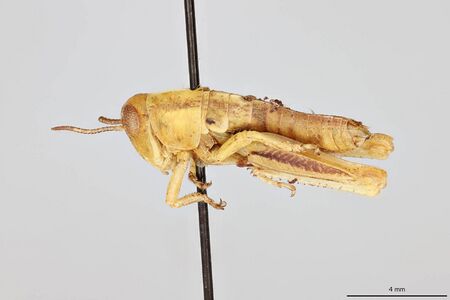
The two-striped grasshopper is a large species with two pale yellow stripes that run from behind the eyes to the tips of the forewings, forming a V-shape. These stripes are often bordered in black on the head and thorax. The body is green or brown with black markings, and the yellowish hind legs feature a solid black stripe. Males have short, wide, boot-shaped cerci and small, triangular furcula set far apart. Nymphs are green or tan with spotted eyes, dark markings on the head, and distinct body stripes. They have a solid black stripe on the upper hind legs and green or yellowish lower legs with black spines and a dark front edge.
Melanoplus thomasi is closely related to M. bivittatus but differs in its bright blue-green coloration, or at least has a green or bluish tint, and vivid red hind legs. Where their ranges overlap, M. bivittatus never shows this coloring, and the two species remain distinct.[2]
Identification details
Melanoplus bivittatus is a large grasshopper species with distinguishing features. It has two pale yellow stripes extending from the back of the eyes, across the lateral lobes of the pronotum, to the tips of the forewings and they converge to form a triangular "V" shape.[3][4] On the head and the pronotum, the stripes are usually bordered below with black.[5][4] M. bivittatus body color ranges from green to brown with black markings[6] and have a solid longitudinal black stripe on their yellowish hind legs. Wings are usually the length of the abdomen. The male cerci are short, wide, and shaped like boots. The furcula projections are also short, triangular, and set far apart.[4]
This species is easy to identify among the Melanoplus group because it is one of the two largest species in the genus, with the other one being Melanoplus differentials.[7]
Two-striped grasshopper nymphs are green or tan and can be recognized by their distinct spots, stripes, and color patterns. Their eyes are brown with many small tan spots and no dark bands. The front of the head is tan or green with dark spots, including a line of spots along the ridges of the frontal costa. A light horizontal stripe appears at the top of the pronotum's side, with a darker brown band above it. The genae are tan or green with spots but lack the pale crescent under the eyes. The hind femur has a solid black stripe that covers most of the upper middle area and slightly extends downward, except near the base. The hind tibia is green or brownish yellow-colored with black spines or black-tipped spines and a dark front edge.[8]
Featured identification resources



All identification resources
| Title | Author(s) | Year | Geographic purview | URL |
|---|---|---|---|---|
| UofA School & Home Integrated Pest Management (IPM) Newsletter Newsletter Grasshoppers | University of Arizona,Dawn H. Gouge, Tom J. Getts, Tim W. Stock, John F. Connett and Micah Gay | 2023 | View URL | |
| Common Grasshoppers of Montana Cropland and Rangeland | Montana State University | View URL | ||
| Grasshoppers of the Choctaw Nation in Southeast Oklahoma | Alex J. Harman, W. Wyatt Hoback and Tom A. Royer | 2021 | View URL | |
| Grasshoppers and their control | Texas A&M University,Carl D. Patrick | View URL | ||
| Insect answers | Daniel Suomi, Gary Thomasson and Dave Keim | 1990 | View URL | |
| Crickets and grasshoppers in Utah | Utah State University | 1931 | View URL | |
| Grasshoppers their habits and damage | United States Department of Agriculture | 1964 | View URL | |
| Utah pests fact sheet | Utah State University,Edward W. Evans and Erin W. Hodgson | 2008 | View URL | |
| Community-wide grasshopper control | Utah State University,Marion Murray | 2020 | View URL | |
| A Manual of the Grasshoppers of New Mexico | New Mexico Cooperative Extension Service,D.B. Richman, D.C. Lightfoot, C.A. Sutherland and DJ. Ferguson | 1993 | View URL | |
| Grasshopper investigations on Montana rangelands | Montana State University,Norman L. Anderson and John C. Wright | 1952 | View URL | |
| The grasshoppers and other orthoptera of Arizona | University of Arizona,E. Ball, E. R. Tinkham, Robert Flock and C. T. Vorhies | 1942 | View URL | |
| Orthoptera of Northern Great Plains | North Dakota State University | 2007 | ||
| Hopper helper | Wendal Cushing | View URL | ||
| The grasshoppers of Nebraska | Animal and Plant Health Inspection Service,Mathew L. Brust, Wyatt Hoback and Robert J. Wright | 2009 | View URL | |
| Common Wyoming pest grasshoppers | University of Wyoming,Scott Schell and Alexandre Latchininsky,B.A. Shambaugh | View URL | ||
| Field guide to grasshoppers of economic importance in Nevada | University of Nevada | View URL | ||
| Field guide to some of the common grasshoppers of the Front Range of Colorado | University of Colorado | View URL | ||
| Montana.gov Orthoptera Field Guides | View URL | |||
| Field crop and forage pests and their natural enemies in Western Canada | Agriculture and Agri-Food Canada | 2018 | View URL | |
| Field Guide to Common Western Grasshoppers | United States Department of Agriculture,Robert E. Pfadt | 2002 | ||
| Grasshoppers of the Western United States | United States Department of Agriculture | View URL | ||
| ARS grasshopper species fact sheets | Agricultural Research Services and United States Department of Agriculture | 1994 | ||
| The Grasshoppers of the Western U.S. Lucid mobile app | APHIS PPQ Science & Technology Insect Management and Molecular Diagnostics Laboratory (Phoenix Station), United States Department of Agriculture and Center for Plant Health Science and Technology of the USDA | 2016 | ||
| Rangeland Grasshopper Management | University of Wyoming,Jeffrey Lockwood and Scott Schell | 1993 |
Distribution
The two-striped grasshopper is widely distributed across North America and southern Canadian provinces.[4] It is abundant in Montana and barely found in Florida.[9] The adults are capable of dispersal and migration flights at altitudes 1,400 feet above the ground and they develop longer wings and slimmer bodies when present in high density.[3]
Biology
The two-striped grasshopper is an early spring hatching species. [4] M. bivittatus oviposition sites tend to be along fence rows, ditch banks, and pastures with compact, undisturbed soil. [10] The eggs are laid in the soil during the winter and hatch by late April to early May.[11] These eggs begin embryonic growth in the summer of deposition and attain 60 to 80 percent development before they go into diapause for the winter. When soil temperatures rise in spring, the embryos complete development, and hatching begins.[12] Eggs begin hatching 8 to 10 days earlier than those of the migratory grasshopper (Melanoplus sanguinipes). The hatching period can last 4 to 6 weeks, mostly depending on spring soil temperatures. Hatching often occurs in two or more waves, usually triggered by rain and warmer weather.[8] After hatching, nymphs emerge from these eggs takes the 43.3 days on average to turn into adults.[13]
Adults usually appear in early summer, though timing can vary by up to 50 days depending on the year, and last until September.[8][4] Grasshoppers that enter crops often return to field edges or roadsides to reproduce. After turning into an adult, they take 6.4 days to start copulating.[12] Males approach females quietly and leap to mate, performing a brief courtship by shaking their hind legs. Females lay eggs one to two weeks later, often at sunny, compact soil sites like ditch banks or field edges, choosing grass crowns or weed roots.[8] Life cycle is completed in a year besides at high elevations in Canada a second year is needed[4]
Photos of this species
-
Melanoplus bivittatus -

Melanoplus bivittatus -

Melanoplus bivittatus -

Melanoplus bivittatus


Habitat and ecology
Melanoplus bivittatus is a polyphagous species that is adaptable and found in a variety of habitats.[4] It is abundant in wet meadows, tallgrass prairie, dense vegetation along water courses, fence rows, roadsides, ditch banks, disturbed weedy areas, in fallow fields, and along crop borders.[10][5][8] These grasshoppers usually exhibit migratory behavior during their nymphal and adult stages, and they move in high densities when they reach third or older instars. They feed on a variety of grasses, forbs, trees, shrubs, and many cultivated plants. Their main food sources are plants like forbs and lentil crops. They consume mustards, flixweed, pepperweed, broadleaf plantain, legumes like alfalfa and red clover, and composites such as greenflower, dandelion, chicory, prickly lettuce, giant ragweed, and arrowleaf butterbur. Ball mustard, western ragweed, prairie sunflower, perennial sowthistle, kochia, and leadplant might also be primary host plants. Additionally, the two-striped grasshopper will consume dry litter found on the ground.[8] The two-striped grasshopper possesses unique adaptations that allow it to feed on toxic plants such as timber milkvetch.[14]
During colder weather, below 25C, they stop feeding.[9] In times of food shortage, the two-striped grasshopper has been observed resorting to cannibalism as a survival strategy.[15] Natural enemies include at least 12 species of parasitic insects, two nematode species, parasitic mites, and also bacterial pathogens.[16] This species if a favorite food of larger birds.[1]
Land-use change
The two-striped grasshopper is a relatively large species known for its high consumption of green vegetation and rapid reproduction. These traits, along with the expansion of agriculture following European settlement, enabled it to spread beyond small, disturbed or lush prairie patches and emerge as a significant pest of cereal crops, forages, and oilseeds.[14] Its populations began rising around 1928, coinciding with the intensification of farming in the western regions.[8] Early settlers unintentionally introduced nutritious host plants for these grasshoppers by sowing seeds of various weeds with their crops. These weeds flourished along crop borders, roadsides, and ditch banks, providing ideal egg-laying sites. These factors and favorable weather conditions supported their population growth which led to one of the worst outbreaks in 1931. In urban areas the two-striped grasshopper is a common pest of flowers and vegetables.[8]
Due to the drought weather conditions in Southern Alberta in 2023, grasshopper populations have increased significantly. The two-striped grasshopper has become one of the three main species attacking crops in Idaho.[17] These dry climate-loving insects invaded the Western United States too, in 2021, where they have easily outcompeted larger animals for grass.[18]
Pest status
The two-striped grasshopper is one of the top dozen species monitored by USDA Animal and Plant Health Inspection Service (APHIS). It is a major crop pest, causing serious damage to small grains, alfalfa, and corn, and can destroy entire fields during outbreaks.[8] Just 10 adults per square yard can completely defoliate corn, though sorghum taller than 6 inches is mostly unaffected. When feeding on spring wheat, they waste six times more plant material than they eat.[8] Damage occurs throughout their life cycle, especially near weedy areas, and they often consume plant reproductive parts, reducing the chances of regrowth or seed production.[11] Sorghum may be resistant to this species.[19]
Management
Surveys by APHIS and its partners conducted in late summer aim to locate two-striped grasshopper egg-laying sites. Another survey in late spring is scheduled to align with grasshopper hatching, helping to identify areas with high nymph concentrations for targeted treatment.[19]
The main strategy for managing two-striped grasshopper infestations on rangelands involves the use of insecticides applied via all-terrain vehicle (ATV)-mounted or aerial sprayers. Recommended insecticides include diflubenzuron, malathion, chlorantraniliprole, various pyrethroids, and carbaryl. Carbaryl can also be used in bait form, as the two-striped grasshopper readily consumes bait. Applications are made either through full-area coverage or using a method known as Reduced Agent and Area Treatments (RAATs). RAATs are an integrated pest management (IPM) technique where insecticide rates are lowered from standard levels, and treated swaths are alternated with untreated ones, reducing total coverage to 50% or less. This method combines direct chemical control (killing grasshoppers in treated areas and as they migrate from untreated zones) with conservation biological control, allowing natural enemies in untreated areas to help suppress the population. This IPM strategy can cut both insecticide use and treatment costs by more than half. Control efforts typically achieve around 80% effectiveness, which is adequate to suppress two-striped grasshopper populations. The insect growth regulator diflubenzuron has shown particular success in RAAT applications due to its long-lasting residual toxicity, which persists for about three weeks.[19][20][21] Pesticide control application rates for this species are available based on 2019 information in [19].
In vegetable gardens, the two-striped grasshopper can be managed using the biopesticide, Paranosema locustae, applied as bait on wheat bran. Recommended rates range from 1,121 to 2,242 g/ha, with higher doses for heavier infestations. A second treatment may be applied after 4–6 weeks. P. locustae acts slowly, killing grasshoppers within 2–3 weeks, though low humidity can reduce its effectiveness. In some cases, infected two-striped grasshoppers that survive may transmit the pathogen to their offspring through their eggs.[19]
Outbreaks
In the 1930s, Melanoplus bivittatus, along with the differential grasshopper (Melanoplus differentialis) destroyed 75 percent of the crops over an area of 17,000 square miles[22] and were responsible for the destruction of crops in an area of 30,000 square miles in South Dakota and Northeastern Nebraska. [13] These grasshoppers would often enter houses, leave salivary secretions on clothes, and chew holes in curtains and upholstery. They also became a nuisance to motorists, as they would fly into the driver’s face, and windshields of cars were smeared by the crushed bodies of these grasshoppers, which often caused accidents that led to some unfortunate deaths. They had some similar outbreaks in Minnesota, Kansas, Oowa, Nebraska, Colorado, Arkansas and Texas.[13]
Between 1984 and 1986, two-striped grasshopper inflicted crop losses valued at tens of millions of dollars on cereal fields in Alberta and Saskatchewan. Its population was partially controlled by a strain of the fungus Entomophaga grylli, which primarily targets this species.[23][1]
Media coverage
Associated organizations
No results found in the database at this time—please reach out if you have any to share!
Resources
| Title | Author(s) | Year | Geographic purview | URL |
|---|---|---|---|---|
| UofA School & Home Integrated Pest Management (IPM) Newsletter Newsletter Grasshoppers | University of Arizona,Dawn H. Gouge, Tom J. Getts, Tim W. Stock, John F. Connett and Micah Gay | 2023 | View URL | |
| Common Grasshoppers of Montana Cropland and Rangeland | Montana State University | View URL | ||
| Grasshoppers of Colorado presentation | University of Colorado | N/A | View URL | |
| USDA grasshopper ecology and economics presentation | United States Department of Agriculture | N/A | View URL | |
| Prairie Pest Monitoring Network (PPMN) | ||||
| How to control grasshoppers in Oklahoma | Oklahoma State University,Fenton FA | 1937 | View URL | |
| Grasshoppers of the Choctaw Nation in Southeast Oklahoma | Alex J. Harman, W. Wyatt Hoback and Tom A. Royer | 2021 | View URL | |
| Grasshopper Management in Rangeland, Pastures, and Crops | Tom A. Royer and Phillip G. Mulder | View URL | ||
| Kansas State University research and extension grasshopper info | Kansas State University | 2023 | View URL | |
| Grasshoppers and their control | Texas A&M University,Carl D. Patrick | View URL | ||
| Grasshopper management in the Pacific Northwest | Carmen Willmore, Jason Thomas and Steven Hines | 2020 | View URL | |
| Insect answers | Daniel Suomi, Gary Thomasson and Dave Keim | 1990 | View URL | |
| Grasshopper and Mormon Cricket Outbreaks in Oregon Frequently Asked Questions | Oregon Department of Agriculture | 2022 | ||
| Crickets and grasshoppers in Utah | Utah State University | 1931 | View URL | |
| Grasshoppers their habits and damage | United States Department of Agriculture | 1964 | View URL | |
| Utah pests fact sheet | Utah State University,Edward W. Evans and Erin W. Hodgson | 2008 | View URL | |
| Community-wide grasshopper control | Utah State University,Marion Murray | 2020 | View URL | |
| A Manual of the Grasshoppers of New Mexico | New Mexico Cooperative Extension Service,D.B. Richman, D.C. Lightfoot, C.A. Sutherland and DJ. Ferguson | 1993 | View URL | |
| Grasshopper investigations on Montana rangelands | Montana State University,Norman L. Anderson and John C. Wright | 1952 | View URL | |
| The grasshoppers and other orthoptera of Arizona | University of Arizona,E. Ball, E. R. Tinkham, Robert Flock and C. T. Vorhies | 1942 | View URL | |
| Orthoptera of Northern Great Plains | North Dakota State University | 2007 | ||
| Hopper helper | Wendal Cushing | View URL | ||
| The grasshoppers of Nebraska | Animal and Plant Health Inspection Service,Mathew L. Brust, Wyatt Hoback and Robert J. Wright | 2009 | View URL | |
| Common Wyoming pest grasshoppers | University of Wyoming,Scott Schell and Alexandre Latchininsky,B.A. Shambaugh | View URL | ||
| Field guide to grasshoppers of economic importance in Nevada | University of Nevada | View URL | ||
| Field guide to some of the common grasshoppers of the Front Range of Colorado | University of Colorado | View URL | ||
| Montana.gov Orthoptera Field Guides | View URL | |||
| Field crop and forage pests and their natural enemies in Western Canada | Agriculture and Agri-Food Canada | 2018 | View URL | |
| Field Guide to Common Western Grasshoppers | United States Department of Agriculture,Robert E. Pfadt | 2002 | ||
| Grasshoppers of the Western United States | United States Department of Agriculture | View URL | ||
| ARS grasshopper species fact sheets | Agricultural Research Services and United States Department of Agriculture | 1994 | ||
| The Grasshoppers of the Western U.S. Lucid mobile app | APHIS PPQ Science & Technology Insect Management and Molecular Diagnostics Laboratory (Phoenix Station), United States Department of Agriculture and Center for Plant Health Science and Technology of the USDA | 2016 | ||
| Rangeland Grasshopper Management | University of Wyoming,Jeffrey Lockwood and Scott Schell | 1993 |
Specimen contributors for this species
 Natural history collections are built by people. The specimens that document this species were collected in the field, preserved in collections, and identified by generations of researchers and naturalists. Bionomia helps make these often-overlooked contributions visible by linking specimen records to the people behind them.
The contributors shown here are drawn from specimen records made available through GBIF and attributed to individuals by Bionomia.
Collected by
These people collected specimens of this species in the field, helping build the physical record of where and when it has occurred.
- Karolina Fucikova — 18 specimens collected
- Mark Olivier — 17 specimens collected
- Mark Rosenstein — 15 specimens collected
- Jacob Gorneau — 10 specimens collected
- Abbott William Nason — 9 specimens collected
Identified by
These people examined specimens and determined their taxonomic identity—an essential step in turning a collected specimen into a useful biodiversity record.
- Tyler Grant — 606 specimens identified
- Christopher Friesen — 31 specimens identified
- Mark Olivier — 11 specimens identified
- Jacob Gorneau — 7 specimens identified
- Elliott Gordon — 5 specimens identified
References
- ↑ 1.0 1.1 1.2 1.3 Johnson DL (n.d.) Spur-throated grasshoppers of the Canadian Prairies and Northern Great Plains. Environmental Health, Agriculture and Agri‑Food Canada Research Centre, Lethbridge, AB & University of Lethbridge, Lethbridge, AB, Canada. https://hopperwiki.org/images/8/84/Spur-throated_grasshopper_of_the_Canadian_Prairies_and_Northern_Great_Plains.pdf
- ↑ BugGuide (n.d.) Melanoplus bivittatus – Two‑striped grasshopper. Iowa State University. https://bugguide.net/node/view/7622
- ↑ 3.0 3.1 Schell SP, Latchininsky AV, Shambaugh BA (2005) Common Wyoming Pest Grasshoppers. 2nd Edition B-1161. Laramie, WY: University of Wyoming Cooperative Extension Service and Department of Renewable Resources. 76 p.
- ↑ 4.0 4.1 4.2 4.3 4.4 4.5 4.6 4.7 Capinera JL, Scott RD, Walker TJ (2005) Field guide to grasshoppers, katydids, and crickets of the United States. Cornell University Press, Ithaca, New York, 280 pp.
- ↑ 5.0 5.1 Montana Field Guide (n.d.) Two-Striped Grasshopper - Melanoplus bivittatus. Retrieved March 27, 2024, from https://fieldguide.mt.gov/speciesDetail.aspx?elcode=IIORT01090
- ↑ Vickery VR and Kevan DKM (1985) The grasshopper, crickets, and related insects of Canada and adjacent regions. Biosystematics Research Institute, Ottawa, Ontario. Publication Number 1777. 918 pp. https://publications.gc.ca/collections/collection_2016/aac-aafc/agrhist/A42-42-1985-14-eng.pdf
- ↑ Government of Alberta (n.d.) Two-Striped Grasshopper. Retrieved March 26, 2024, from https://www.alberta.ca/two-striped-grasshopper
- ↑ 8.00 8.01 8.02 8.03 8.04 8.05 8.06 8.07 8.08 8.09 Pfadt RE (1994) Twostriped Grasshopper 'Melanoplus bivittatus' (Say). Wyoming Agricultural Experiment Station Bulletin 912. Species Fact Sheet. https://www.ars.usda.gov/ARSUserFiles/30320505/grasshopper/Extras/PDFs/Species%20Fact%20Sheets/2striped.pdf
- ↑ 9.0 9.1 Harrison JF and Fewell JH (1995) Thermal Effects on Feeding Behavior and Net Energy Intake in a Grasshopper Experiencing Large Diurnal Fluctuations in Body Temperature. Physiological Zoology. 68 (3): 453–473.
- ↑ 10.0 10.1 Capinera JL (2008) Twostriped grasshopper, Melanoplus bivittatus (Say), (Orthoptera: Acrididae). In Encyclopedia of Entomology. Springer, Dordrecht. https://doi.org/10.1007/978-1-4020-6359-6_2603
- ↑ 11.0 11.1 Olfert O and Slinkard A (1999) Grasshopper (Orthoptera: Acrididae) damage to flowers and pods of lentil (Lens culinaris L.). Crop Protection. 18 (8): 527–530. doi:10.1016/s0261-2194(99)00056-3
- ↑ 12.0 12.1 Agricultural Research Service (n.d.) Two Striped Grasshopper: Melanoplus bivittatus (say) [Fact Sheet]. U. S. Department of Agriculture. https://www.ars.usda.gov/ARSUserFiles/30320505/grasshopper/Extras/PDFs/Species%20Fact%20Sheets/2striped.pdf
- ↑ 13.0 13.1 13.2 Shotwell RL (1941) Life histories and habits of some grasshoppers of economic importance on the Great Plains (Vol. Technical Bulletin No. 774). United States Department of Agriculture.
- ↑ 14.0 14.1 Johnson DL, Majak W, Benn MH (2001) Excretion of miserotoxin and detoxification of the aglycone by grasshoppers (Orthoptera: Acrididae). Phytochemistry 58: 739–742.
- ↑ Gangwere SK (1961) A monograph on food selection in Orthoptera. Transactions of the American Entomological Society. 2 (87): 67–230
- ↑ Beirne BP (1972) Pest insects of annual crop plants in Canada. IV. Hemiptera-Homoptera, V. Orthoptera, VI. Other groups. Volumes 78-85 of Memoirs of the Entomological Society of Canada. 84:1-73.
- ↑ Jaynes L (2022) Grasshopper watch. Ag Proud. https://www.agproud.com/articles/55887-grasshopper-watch
- ↑ Woodruff G (2021) Grasshoppers, drought, farming, West, swarms. Slate. https://slate.com/technology/2021/07/grasshoppers-drought-farming-west-swarms.html
- ↑ 19.0 19.1 19.2 19.3 19.4 Latchininsky A (2019) Two-striped grasshopper Melanoplus bivittatus (Say, 1825) (Acrididae)). In: Lecoq M, Zhang L (Eds) Encyclopedia of pest Orthoptera of the world. China Agricultural University Press, Beijing, China, pp. 143–147.
- ↑ Latchininsky AV, Schell SP (2007) Aerial RAATs brochure. ATV-RAATs brochure. UW CES Bulletin MP-95, Laramie, WY, USA.https://hopperwiki.org/index.php/UWYO_information_on_reduced_agent_and_area_treatments_(RAATs)
- ↑ Lockwood JA, Schell SP (1997) Decreasing economic and environmental costs through reduced area and agent insecticide treatments (RAATs) for the control of rangeland grasshoppers: empirical results and their implications for pest management. Journal of Orthoptera Research 6: 19–32.
- ↑ Parker JR and Shotwell RL (1932) Devastation of a Large Area by the Differential and the Two-Striped Grasshoppers. Journal of Economic Entomology. 25 (2): 174–187. https://doi.org/10.1093/jee/25.2.174
- ↑ Erlandson MA, Johnson DL, Olfert OO (1988) Entomophaga grylli (Fresenius) infections in grasshopper (Orthoptera: Acrididae) populations in Saskatchewan and Alberta, 1985–1986. The Canadian Entomologist 120: 205–209.