El Salvador
| El Salvador | |
|---|---|
.svg) | |
| El Salvador is within: | |
| Region: | Americas |
| Subregion: | Latin America and the Caribbean |
| Intermediate region: | Central America |
El Salvador is the smallest country in Central America. It is bordered by Honduras to the north and northeast, Nicaragua to the east across the Gulf of Fonseca, the Pacific Ocean to the south, and Guatemala to the west and northwest. In 2021, the total rural population was 1,685,520 and the total crop cultivated area was 881,000 ha. [1]
Farmers make up just 14 percent of the economically active population, with most being subsistence smallholders, who operate on plots smaller than 2.1 hectares, consuming nearly all of their production of staple foods like maize and beans and live on less than $200 per month. [2] [3]
The country has seen modest economic growth in recent decades, averaging an annual rate of 2.5 percent from 2013 to 2019. National poverty rates present a mixed picture: moderate poverty has remained relatively stable, slightly below pre-pandemic levels despite a rise between 2019 and 2020, while extreme poverty increased in 2022, remaining 4.1 percentage points higher than the 2019 rate.
Food security is persistently at risk due to climate fluctuations, extreme weather events linked to climate change, and internal issues like erosion, deforestation, insufficient conservation efforts, and excessive use of agrochemicals. [4]
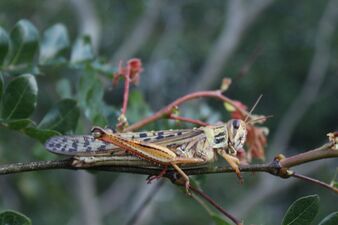
The CAL was declared a national pest in 1955 in El Salvador. Recent outbreaks were reported in 2016 and 2018. [5]
Species gallery
- Highlighted species for El Salvador
-

-

-

-

-

-
-

-

-

Organizations
Locusts and grasshoppers are typically managed through a national plant protection system led by a country’s plant protection organization, ministry of agriculture, or equivalent biosecurity authority. They are often supported by specialized pest control branches, natural resource agencies, and regional bodies when outbreaks cross borders. These agencies are usually the first point of contact for surveillance, reporting, permits, quarantine decisions, and control operations. If the country belongs to one of the FAO locust commissions, those bodies provide a regional framework for early warning, field surveillance, information sharing, and coordinated response, helping countries align monitoring, contingency planning, and control actions across borders.
| Organization name | Acronym | Website | Type | Focus | Geographic purview |
|---|---|---|---|---|---|
| Inter-American Institute for Cooperation on Agriculture | IICA | View | Non-governmental Organization | Development | Antigua and Barbuda, Argentina, Bahamas, Barbados, Belize, Bolivia, Brazil, Canada, Chile, Costa Rica, Colombia, Dominica, Dominican Republic, Ecuador, El Salvador, Guatemala, Grenada, Guyana, Haiti, Honduras, Jamaica, Mexico, Nicaragua, Panama, Paraguay, Peru, Saint Kitts and Nevis, Saint Lucia, Saint Vincent and the Grenadines, Suriname, Trinidad and Tobago, United States, Uruguay, Venezuela |
| International Regional Organization of Plant and Animal Health | OIRSA | View | Intergovernmental Organization | Management, Governance, Education | Mexico, Guatemala, El Salvador, Honduras, Nicaragua, Costa Rica, Panama, Dominican Republic |
Resources
| Name | Species purview | Year published | Resource link | Descriptive keyword | Language | Geographic purview | Author |
|---|---|---|---|---|---|---|---|
| Action plan for managing the Central American locust | 2019 | View | Management, Biology, Species identification, Biopesticide, Robotics, Drones, Technology, Pesticide management, Survey | Spanish | Mexico, Guatemala, El Salvador, Honduras, Nicaragua, Costa Rica, Panama, Dominican Republic | International Regional Organization of Plant and Animal Health | |
| Situation and recommendations for controlling the Central American locust in the countries of the OIRSA region | 2020 | View | Management, Geographical differences, Situation bulletin | Spanish | Mexico, Belize, Guatemala, El Salvador | International Regional Organization of Plant and Animal Health |
Highlighted media coverage
No results found in the database at this time—please reach out if you have any to share!
Projects
No results found in the database at this time—please reach out if you have any to share!
References
- ↑ Food and Agriculture Organization of the United Nations (FAO) (2021) AQUASTAT database. Retrieved September 9, 2024, from https://data.apps.fao.org/aquastat/?lang=en
- ↑ Inter-American Institute for Cooperation on Agriculture (IICA) (2012) El Salvador shows its commitment to family agriculture. IICA. https://iica.int/en/press/news/el-salvador-shows-its-commitment-family-agriculture
- ↑ World Bank (n.d.) El Salvador overview. World Bank. Retrieved September 9, 2024, from https://www.worldbank.org/en/country/elsalvador/overview
- ↑ Food and Agriculture Organization of the United Nations (2015) Perfil de País – El Salvador. Retrieved September 9, 2024, from https://openknowledge.fao.org/server/api/core/bitstreams/97b0829c-ccbe-4613-a8fe-0cd591b9079b/content
- ↑ Organismo Internacional Regional de Sanidad Agropecuaria (OIRSA) (2019) Plan de acción de manejo de la langosta centroamericana. Primera edición, marzo 2019. 80p. www.oirsa.org https://hopperwiki.org/images/1/14/Action_plan_for_managing_the_Central_American_locust.pdf