North Dakota
| North Dakota | |
|---|---|
 | |
| North Dakota is within: | |
| Country: | United States |
North Dakota is located in the north-central Great Plains region of the United States. Its wide-open grasslands provide a natural home for grasshoppers, which are common in the state. While they are a normal part of the prairie ecosystem, certain species can become pests during hot, dry years, damaging crops and rangelands.
State ecology
North Dakota is characterized by vast expanses of prairie grasslands, rolling plains, and fertile agricultural land.[1] The state’s semi-arid to subhumid continental climate, with warm summers and cold winters, creates ideal conditions for grassland ecosystems that support a wide range of insect fauna, including grasshoppers.
The region features mixed grass prairie with both cool- and warm-season grasses like blue grama, western wheatgrass, and little bluestem, along with widespread crested wheatgrass. Wooded draws occur in the western badlands, while eastern forests are limited to stream valleys and north-facing slopes. Cattle ranching dominates the rugged badlands, with limited cropland used for winter forage. In the east, dryland farming focuses on cash crops, often alongside small-scale ranching. [2]
Species gallery
- Highlighted species for North Dakota
-

-

-

-

-

-

-

-

-

-

-
-

-

-

-

-

Species of management concern
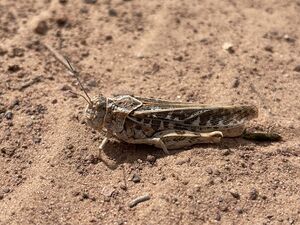
Grasshoppers are a natural component of North Dakota’s prairie ecosystems and play a role in nutrient cycling and food webs. However, several species—particularly the migratory grasshopper (Melanoplus sanguinipes) and the two-striped grasshopper (Melanoplus bivittatus)—are considered significant agricultural pests. Outbreaks can result in extensive damage to cereal crops, alfalfa, and rangelands, particularly during hot, dry summers that favor grasshopper reproduction and survival.
Grasshopper populations in North Dakota tend to fluctuate cyclically, with outbreaks occurring every 7–10 years under favorable climatic conditions. Eggs usually begin hatching in early May, with peak hatching occurring by mid-June and most eggs hatched by late June. [3] Population dynamics are influenced by weather, land use practices, and natural predators. Early monitoring and integrated pest management (IPM) strategies are critical to reducing economic losses while preserving ecological balance.


.jpg)




.jpg)

_in_profile_Mathew_L._Brust.png)

.jpg)




_(43478105211).jpg)


.jpg)


Grasshopper management
The North Dakota Department of Agriculture, in coordination with the USDA Animal and Plant Health Inspection Service (APHIS), regularly conducts surveys to monitor grasshopper densities and predict outbreak potential.[4]
Management approaches in the state emphasize early detection and targeted intervention. Rangeland treatments using reduced agent and area treatments (RAATs)—a method that combines lower insecticide rates with alternating untreated swaths—are commonly employed to minimize environmental impact while maintaining control efficacy. Public outreach and landowner education also play an important role in encouraging responsible pest management.[2]
North Dakota State University (NDSU) engages in critical outreach through their extension programs. They educate farmers and ranchers through publications and outreach, helping them apply effective, environmentally responsible practices. NDSU also contributes to grasshopper management through its research and monitoring programs. It conducts population surveys to detect outbreaks early, develops integrated pest management strategies, and evaluates control methods like targeted insecticide use.[5]
The North Dakota Grasshopper Integrated Pest Management (GHIPM) Demonstration Project, conducted from 1987 to 1993 in western North Dakota and eastern Montana, aimed to manage grasshopper populations and compare the effectiveness of an integrated pest management approach versus traditional chemical control methods. The project also sought to evaluate the effectiveness of early sampling in detecting infestations, assess the short- and long-term effects of treatments on grasshopper populations, and develop new suppression techniques with minimal impact on non-target species.[6]
They concluded that to improve grasshopper management, increased sampling to better define infestation areas, carefully timed treatment applications, and the use of hot-spot treatments with ground-based insecticidal sprays or baits should replace large-scale aerial applications. Results from the GHIPM Demonstration Project show that these more targeted methods significantly reduce both the cost of grasshopper control and the amount of insecticide used on rangeland.[6]
Featured resource

Select photos from North Dakota
No images found for this query -- should be coming soon!
Outbreaks
Heavy grasshopper infestations often occur in areas with low rainfall or during drought years. Outbreaks are typically preceded by several years of hot, dry summers and warm falls. In contrast, cool, wet weather promotes disease and slows grasshopper development, leading to a decrease in population.[3]
Organizations
No results found in the database at this time—please reach out if you have any to share!
Resources
| Name | Year published | Resource link | Descriptive keyword | Language | Author |
|---|---|---|---|---|---|
| APHIS regulatory documents | 2018 | Early warning, Ecology, Public health, Social science, Culture, insecticide, Infestations, Environmental assessment, Rangeland management, Pesticides, Bundle, Environmental impact | English | Animal and Plant Health Inspection Service | |
| ARS grasshopper species fact sheets | 1994 | Management, Species identification, Series | English | Agricultural Research Services, United States Department of Agriculture | |
| CARMA | View | Prototype cropland, Advice, Rangeland management, Crop health, Grasshoppers, Infestations, Outbreaks | English | Scott Shell Extension Entomology, University of Wyoming | |
| Court rejects federal pesticide-spraying program on millions of acres of western rangelands | 2025 | Ecology, Spraying, Chemical control, Infestations, Management, Governance, Conservation, Land use management, Habitat | English | ||
| Crop & pest report | View | Crop health, Infestations, Grasshoppers, Growth, Information hub | English | North Dakota State University | |
| Field Guide to Common Western Grasshoppers | 2002 | Species identification, Field guide | English | United States Department of Agriculture, Robert E. Pfadt | |
| Grasshopper infestation continues after pesticide spray canceled | 2023 | Spraying, Ecology, Environmental science, Infestations, Emergency response, Chemical control, Grazing | English | Alaina Mencinger | |
| Grasshopper Integrated Pest Management User Handbook | 2000 | Biological control, Chemical control, Monitoring, Modeling, Population dynamics, Rangeland management, Decision making, Bundle, Ecology, Pesticides, Biopesticide, Integrated pest management | English | Agricultural Research Services, United States Department of Agriculture | |
| Grasshopper IPM program | View | Integrated pest management, Infestations, Economics, Cultural control, Control, Aerial control operations, insecticide, Chemical control | English | North Dakota State University | |
| Grasshopper watch | 2022 | Grasshoppers | English | ||
| Grasshoppers Are Descending on the West in Swarms | 2021 | Grasshoppers | English | ||
| Grasshoppers of the Western United States | View | Management, Species identification, Key | English | United States Department of Agriculture | |
| Grasshoppers their habits and damage | 1964 | View | Grasshoppers, Outbreaks, Natural enemies, Ecology, Habitat, Quality illustrations, Species identification | English | United States Department of Agriculture |
| Hopper helper | View | Survey, Life cycle, Species identification, Integrated pest management | English | Wendal Cushing | |
| Mega Disasters: Super Swarms of Locusts | 2021 | General locust education, Video | English | ||
| Montana.gov Orthoptera Field Guides | View | Species identification, Management, Biology, Distribution, Map, Rangeland management, Information hub, Website | English | ||
| Mormon cricket 'sludge' blankets northern Nevada roads causing crashes | 2024 | Media article, Outbreaks | English | ||
| North Dakota field crop insect management guide | 2023 | View | Grasshoppers, Management, insecticide, Data analysis, Chemical control, Rangeland management | English | North Dakota State University, Janet J. Knodel, Patrick Beauzay, Mark Boetel, Anitha Chirumamilla |
| Orthoptera of Northern Great Plains | 2007 | Information hub, Species identification, Taxonomy, Map, Photos, Nymphs | English | North Dakota State University | |
| Overview of the APHIS Rangeland Grasshopper and Mormon Cricket Suppression Program | 2022 | Management, Chemical control, Grasshoppers, Governance, Video | English | APHIS PPQ Science & Technology Insect Management and Molecular Diagnostics Laboratory (Phoenix Station), United States Department of Agriculture | |
| Overview of the APHIS Rangeland Grasshopper and Moron Cricket Suppression Program | 2022 | Video, Grasshoppers, Management, Educational video | English | United States Department of Agriculture, APHIS Plant Protection and Quarantine | |
| Pest Grasshoppers of the West | 2005 | View | Management, Species identification | English | University of Wyoming |
| Protecting U.S. rangeland from grasshoppers and Mormon crickets | 2021 | View | Outbreaks, Infestations, Mormon crickets, Rangeland management, insecticide | English | United States Department of Agriculture |
| Rangeland Grasshopper and Mormon Cricket suppression program | 2019 | View | Public health, Governance, Culture, Grasshoppers, Economics, Environmental assessment, Life cycle, Biology | English | United States Department of Agriculture |
| Rangeland Grasshopper Management | 1993 | Management, Species identification, Control | English | University of Wyoming, Jeffrey Lockwood, Scott Schell | |
| The Grasshoppers of the Western U.S. Lucid mobile app | 2016 | Management, Species identification | English | APHIS PPQ Science & Technology Insect Management and Molecular Diagnostics Laboratory (Phoenix Station), United States Department of Agriculture, Center for Plant Health Science and Technology of the USDA | |
| The North Dakota grasshopper integrated pest management demonstration project | 2000 | View | Management, Integrated pest management, Aerial control operations, Spraying, Control, Outbreaks | English | United States Department of Agriculture, Mark A. Quinn, R. Nelson Foster, Wendal Cushing, David C. Hirsch, Keith Winks, K. Christian Reuter |
| USDA APHIS grasshopper forecasting and survey map collection | 1930s | Control, Management, Rangeland management, Map, APHIS archive 2024, Grasshoppers, Outbreaks, Forecasting, Historical document, Survey, Uncurated archive, Collection, Historical maps | English | APHIS Plant Protection and Quarantine, United States Department of Agriculture | |
| USDA APHIS historical meeting report collection | APHIS archive 2024, Historical document, Annual report, Uncurated archive, Collection | English | United States Department of Agriculture, Animal and Plant Health Inspection Service | ||
| USDA APHIS-PPQ-Science & Technology Phoenix Lab Rangeland Unit project summary | 2021 | Summary, Set, Project, Project report | English, Spanish, French | APHIS PPQ Science & Technology Insect Management and Molecular Diagnostics Laboratory (Phoenix Station), Animal and Plant Health Inspection Service, United States Department of Agriculture | |
| Which insecticide is best for grasshopper control? | insecticide, Application, Infestations, Agriculture, Crop health, Economics | English | North Dakota State University, Patrick Beauzay, Janet J. Knodel |
References
- ↑ U.S. Geological Survey (USGS) (2025) Ecoregions of North Dakota. U.S. Department of the Interior. https://dmap-prod-oms-edc.s3.us-east-1.amazonaws.com/ORD/Ecoregions/nd/ndsd_front.pdf
- ↑ 2.0 2.1 Animal and Plant Health Inspection Service (2020) Environmental Assessment: Rangeland Grasshopper and Mormon Cricket Suppression Program, North Dakota. EA Number: ND-20-01. United States Department of Agriculture, Animal and Plant Health Inspection Service. https://www.aphis.usda.gov/sites/default/files/nd-20-01.pdf
- ↑ 3.0 3.1 Knodel J, Beauzay P, Boetel M, Chirumamilla A (2024) North Dakota Field Crop Insect Management Guide. North Dakota State University Extension. https://www.ndsu.edu/agriculture/ag-hub/ag-topics/crop-production/insects/field-crop-insect-management-guide
- ↑ North Dakota State University Extension (2024) Crop & Pest Report No. 4, May 30, 2024. North Dakota State University, Fargo, ND. https://www.ndsu.edu/agriculture/sites/default/files/2024-05/4%20CPR%20May%2030%202024%20F.pdf
- ↑ North Dakota State University Extension (2024) Crop & Pest Report. North Dakota State University, Fargo, ND. https://www.ndsu.edu/agriculture/ag-hub/ag-topics/crop-production/crop-pest-report
- ↑ 6.0 6.1 Quinn MA, Foster RN, Cushing WJ, Hirsch DC, Winks K, Reuter KC (2000) The North Dakota Grasshopper Integrated Pest Management Demonstration Project. United States Department of Agriculture, Animal and Plant Health Inspection Service, Technical Bulletin No. 1891, December 2000.