Wyoming
| Wyoming | |
|---|---|
 | |
| Wyoming is within: | |
| Country: | United States |
Wyoming is a large, sparsely populated western U.S. state defined by its open plains, rugged mountains, and diverse ecosystems ranging from alpine forests to sagebrush steppe. The dry climate and extensive rangelands create ideal conditions for grasshopper populations, which are part of the natural ecology but can periodically surge and cause significant damage. State and federal agencies regularly monitor and manage grasshopper outbreaks to protect rangeland health and agricultural productivity.
State ecology
Wyoming's landscape is a mix of high plains, sagebrush steppe, rolling grasslands, and rugged mountain ranges, including parts of the Rocky Mountains and the Greater Yellowstone Ecosystem.[1] Much of the state consists of semi-arid rangeland, supporting a wide array of native grasses, forbs, and shrubs adapted to dry conditions.[2] These ecosystems provide prime breeding grounds for grasshoppers. Outbreaks have historically caused significant damage to Wyoming's grazing lands and agricultural crops, threatening both native ecosystems and ranching economies.
As of 1998, southeastern Wyoming had experienced high grasshopper densities in 27 of the previous 31 years, making it the most persistently infested region in the United States at that time. Historically, grasshopper problems in Wyoming have been most common in Big Horn, Washakie, Hot Springs, Sheridan, Johnson, Campbell, Crook, Weston, Converse, southern Natrona, Niobrara, Goshen, and Platte counties. Other counties have experienced fewer outbreaks due to factors like elevation, vegetation (pine forests or deserts), and other yet-to-be-understood variables.[3]
Chronic grasshopper outbreaks in Wyoming are closely associated with the Ponderosa pine forest vegetation class. Despite its name, the "forest" resembles a savannah, with open or scattered trees and a grass understory. The unique and complex environmental conditions that create these pine savannahs may contribute to the persistence of grasshopper outbreaks.[4]
Species gallery
- Highlighted species for Wyoming
-

-

-

-

-

-

-

-
-

-

-

-

-

-

-

-

Species of management concern
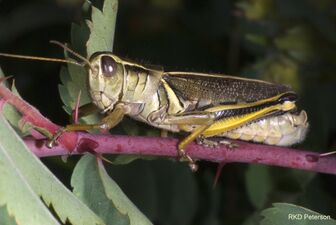
Wyoming is home to around 100 grasshopper species, with 15 of them identified as major pests of rangeland or cropland. The six major grasshopper pest species found in southeastern Wyoming are White-whiskered grasshopper (Ageneotettix deorum), Striped grasshopper (Amphitornus coloradus), Big-headed grasshopper (Aulocara elliotti), Western spotted-winged grasshopper (Cordillacris occipitalis), Migratory grasshopper (Melanoplus sanguinipes), and Two-striped grasshopper (Melanoplus bivittatus). The first four primarily damage rangeland, M. bivittatus targets croplands, and M. sanguinipes affects both. Although outbreaks can involve more than 16 species, typically one or a few of these dominate.[3] The Mormon cricket (Anabrus simplex) is also noteworthy for its destructive impact when large swarms migrate from rangelands to croplands.
Some grasshopper species overwinter as nymphs, emerging earlier in the spring than those that overwinter as eggs. In southeastern Wyoming, brown-spotted range grasshopper (Psoloessa delicatula), velvet-striped grasshopper (Eritettix simplex), and pasture grasshopper (Melanoplus confusus) are among the first to appear. While these species can occasionally damage rangeland when abundant, such occurrences are rare. They should not be mistaken for early hatches of egg-overwintering species.[3]


.jpg)




_(9-6-12)_pena_blanca_lake,_scc,_az_-01_(7945106196).jpg)

.jpg)

_in_profile_Mathew_L._Brust.png)

.jpg)




_(43478105211).jpg)


.jpg)


Grasshopper management
Wyoming manages grasshoppers through a decentralized system built around 23 county Weed & Pest Control Districts, one for each county. These districts are the practical frontline: they work with ranchers, farmers, state and federal land managers, and other partners to monitor outbreaks, provide technical guidance, organize coordinated responses, and sometimes offer pesticide access or cost-share assistance. Statewide coordination comes from the Wyoming Department of Agriculture and the Wyoming Weed & Pest Council.
The system is designed for local flexibility. Grasshopper pressure, funding, staffing, landownership, and agricultural priorities differ greatly across Wyoming, so each county district can tailor its activities to local conditions rather than follow a uniform state treatment program. This is especially important in rangeland landscapes, where infestations often span multiple private and public properties and effective action depends on neighboring land managers participating together.
Wyoming’s approach emphasizes integrated pest management: early monitoring, identification of economically important pest species, treatment only when justified by density and likely damage, and coordination at the relevant landscape scale. When treatment is needed, local and state partners may use methods intended to reduce pesticide use and conserve beneficial organisms, including reduced-rate or alternating-swath approaches associated with the Reduced Area and Agent Treatment strategy (RAATs). Larger or multi-county outbreaks can also trigger support through the state’s Emergency Insect Management Program and collaboration with federal agencies such as USDA APHIS (above paragraphs pers. comm. Scott Schell U. Wyo. Extension Entomology Specialist to Mira Ries GLI project coordinator Sept 24, 2026).
The University of Wyoming has been instrumental in advancing grasshopper research and management, particularly concerning rangeland ecosystems. Through its Department of Ecosystem Science and Management, the university has collaborated with agencies like USDA-APHIS and the Cooperative Agricultural Pest Survey Program to develop comprehensive, species-based surveys and management strategies.[5]
Additionally, the university has established many valuable resources on their platform "Grasshoppers of Wyoming and the West", including field guides, distribution maps, and management strategies.
Featured resource

Select photos from Wyoming
No images found for this query -- should be coming soon!
Outbreaks

Grasshopper outbreaks are a recurring issue in Wyoming, particularly in the state’s rangelands, where favorable environmental conditions and abundant forage can lead to rapid population growth. These outbreaks, which vary in intensity and location from year to year, can cause significant damage to both native vegetation and agricultural lands, prompting ongoing monitoring and management efforts.
For maps of Wyoming grasshopper population dynamics over the years click here
Organizations
No results found in the database at this time—please reach out if you have any to share!
Resources
| Name | Year published | Resource link | Descriptive keyword | Language | Author |
|---|---|---|---|---|---|
| APHIS regulatory documents | 2018 | Early warning, Ecology, Public health, Social science, Culture, insecticide, Infestations, Environmental assessment, Rangeland management, Pesticides, Bundle, Environmental impact | English | Animal and Plant Health Inspection Service | |
| ARS grasshopper species fact sheets | 1994 | Management, Species identification, Series | English | Agricultural Research Services, United States Department of Agriculture | |
| CARMA | View | Prototype cropland, Advice, Rangeland management, Crop health, Grasshoppers, Infestations, Outbreaks | English | Scott Shell Extension Entomology, University of Wyoming | |
| Common Wyoming pest grasshoppers | View | Life cycle, Species identification, Biodiversity, Grasshoppers | English | University of Wyoming, Scott Schell, Alexandre Latchininsky, B.A. Shambaugh | |
| Court rejects federal pesticide-spraying program on millions of acres of western rangelands | 2025 | Ecology, Spraying, Chemical control, Infestations, Management, Governance, Conservation, Land use management, Habitat | English | ||
| Distribution Atlas for Grasshoppers and the Mormon Cricket in Wyoming | Map, Survey, Archive, Population dynamics | English | University of Wyoming | ||
| Field Guide to Common Western Grasshoppers | 2002 | Species identification, Field guide | English | United States Department of Agriculture, Robert E. Pfadt | |
| Grasshopper biology and monitoring | View | Monitoring, Biology, Grasshoppers, General locust education | English | University of Wyoming, Judee Wargo | |
| Grasshopper infestation continues after pesticide spray canceled | 2023 | Spraying, Ecology, Environmental science, Infestations, Emergency response, Chemical control, Grazing | English | Alaina Mencinger | |
| Grasshopper Integrated Pest Management User Handbook | 2000 | Biological control, Chemical control, Monitoring, Modeling, Population dynamics, Rangeland management, Decision making, Bundle, Ecology, Pesticides, Biopesticide, Integrated pest management | English | Agricultural Research Services, United States Department of Agriculture | |
| Grasshopper watch | 2022 | Grasshoppers | English | ||
| Grasshoppers (Acrididae) of Colorado | 1982 | Biology, Species identification, Ecology, Behavior, Physiology, Management | English | Colorado State University, John Capinera, TS Sechrist | |
| Grasshoppers Are Descending on the West in Swarms | 2021 | Grasshoppers | English | ||
| Grasshoppers of the Western United States | View | Management, Species identification, Key | English | United States Department of Agriculture | |
| Grasshoppers their habits and damage | 1964 | View | Grasshoppers, Outbreaks, Natural enemies, Ecology, Habitat, Quality illustrations, Species identification | English | United States Department of Agriculture |
| Hopper helper | View | Survey, Life cycle, Species identification, Integrated pest management | English | Wendal Cushing | |
| Key to Wyoming grasshoppers | Species identification, Information hub, Glossary | English | University of Wyoming, Timothy J. McNary | ||
| Las Vegas resident shares experience as swarms of grasshoppers return to valley | 2024 | Outbreaks | English | ||
| Mega Disasters: Super Swarms of Locusts | 2021 | General locust education, Video | English | ||
| Montana.gov Orthoptera Field Guides | View | Species identification, Management, Biology, Distribution, Map, Rangeland management, Information hub, Website | English | ||
| Mormon cricket 'sludge' blankets northern Nevada roads causing crashes | 2024 | Media article, Outbreaks | English | ||
| Mormon cricket biology and management poster | View | Life cycle, Economics, History, Spraying, Habitat, Migration, Grasshopper development, Distribution, Species identification, Map, Photos | English | University of Wyoming, APHIS Plant Protection and Quarantine | |
| Overview of the APHIS Rangeland Grasshopper and Mormon Cricket Suppression Program | 2022 | Management, Chemical control, Grasshoppers, Governance, Video | English | APHIS PPQ Science & Technology Insect Management and Molecular Diagnostics Laboratory (Phoenix Station), United States Department of Agriculture | |
| Overview of the APHIS Rangeland Grasshopper and Moron Cricket Suppression Program | 2022 | Video, Grasshoppers, Management, Educational video | English | United States Department of Agriculture, APHIS Plant Protection and Quarantine | |
| Pest Grasshoppers of the West | 2005 | View | Management, Species identification | English | University of Wyoming |
| Protecting U.S. rangeland from grasshoppers and Mormon crickets | 2021 | View | Outbreaks, Infestations, Mormon crickets, Rangeland management, insecticide | English | United States Department of Agriculture |
| Rangeland Grasshopper and Mormon Cricket suppression program | 2019 | View | Public health, Governance, Culture, Grasshoppers, Economics, Environmental assessment, Life cycle, Biology | English | United States Department of Agriculture |
| Rangeland Grasshopper Management | 1993 | Management, Species identification, Control | English | University of Wyoming, Jeffrey Lockwood, Scott Schell | |
| The Grasshoppers of the Western U.S. Lucid mobile app | 2016 | Management, Species identification | English | APHIS PPQ Science & Technology Insect Management and Molecular Diagnostics Laboratory (Phoenix Station), United States Department of Agriculture, Center for Plant Health Science and Technology of the USDA | |
| UC Integrated Pest Management for Home Gardeners and Landscape Professionals | 2013 | View | Life cycle, Pesticide management, Management | English | University of California Statewide Integrated Pest Management Program |
| USDA APHIS historical meeting report collection | APHIS archive 2024, Historical document, Annual report, Uncurated archive, Collection | English | United States Department of Agriculture, Animal and Plant Health Inspection Service | ||
| USDA APHIS-PPQ-Science & Technology Phoenix Lab Rangeland Unit project summary | 2021 | Summary, Set, Project, Project report | English, Spanish, French | APHIS PPQ Science & Technology Insect Management and Molecular Diagnostics Laboratory (Phoenix Station), Animal and Plant Health Inspection Service, United States Department of Agriculture | |
| Wyoming Grasshopper Maps | Map, Survey, Archive, Population dynamics | English | University of Wyoming |
References
- ↑ U.S. Geological Survey (USGS) (2025) Ecoregions of Wyoming. U.S. Department of the Interior. https://dmap-prod-oms-edc.s3.us-east-1.amazonaws.com/ORD/Ecoregions/wy/wy_front.pdf
- ↑ University of Wyoming Extension (n.d.) Wyoming ecoregions. Wyoming Rangelands—Rangeland Resources. University of Wyoming. https://uwyoextension.org/uwrange/rangeland-resources/wyoming-ecoregions/
- ↑ 3.0 3.1 3.2 University of Wyoming (n.d.) Rangeland Grasshopper Management. Retrieved from https://www.uwyo.edu/entomology/grasshoppers/rgmanage.html
- ↑ Schell SP, Lockwood JA (1997) Spatial analysis of ecological factors related to rangeland grasshopper (Orthoptera: Acrididae) outbreaks in Wyoming. Environmental Entomology 26: 1343–1353. https://doi.org/10.1093/ee/26.6.1343
- ↑ Lockwood JA, McNary TJ, Larsen JC, Zimmerman K, Shambaugh B, Latchininsky A, Herring B, Legg C (2018) Distribution Atlas for Grasshoppers and the Mormon Cricket in Wyoming: 1988–2018. University of Wyoming in cooperation with USDA APHIS PPQ and the Cooperative Agricultural Pest Survey Program. Updated by Schell S, Zimmerman K. https://www.uwyo.edu/entomology/grasshoppers/field-guide/ghatlas.html